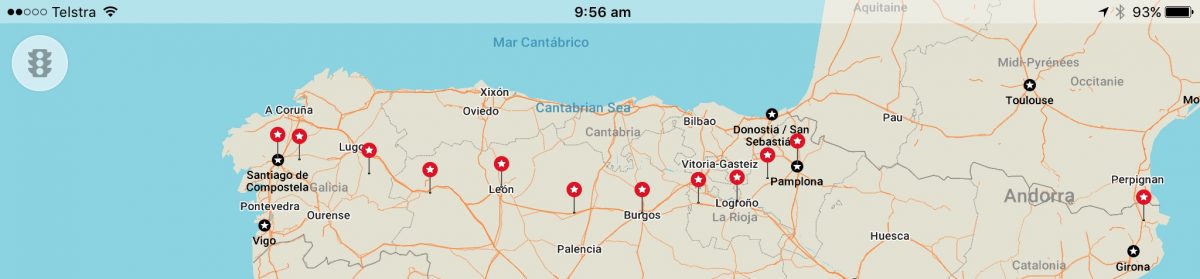
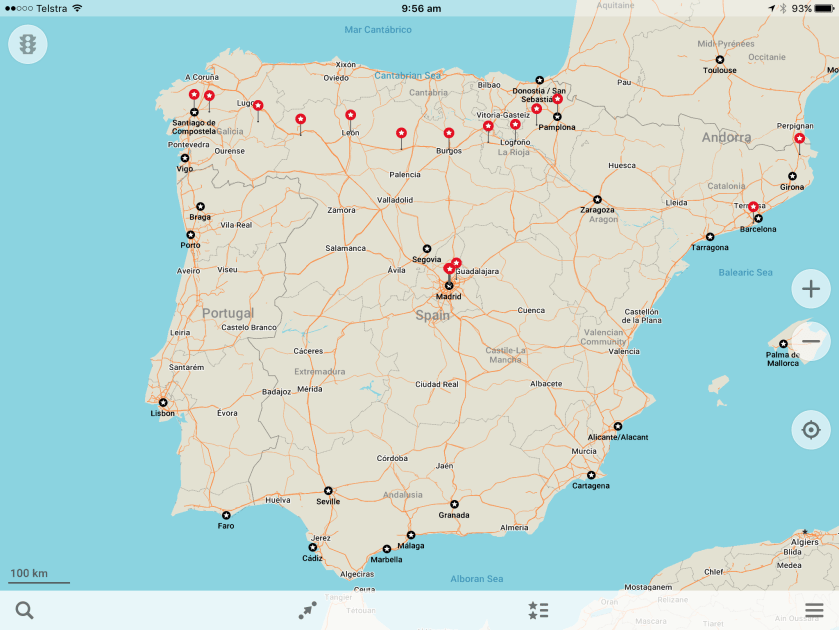
Our journey – east to west. The pins mark our overnight stopsEssential training – wineEssential training – walkingEssential training – eating
Welcome to my blog!! Over the next four weeks, John & I will be traveling around Spain. After flying into Madrid and traveling to Pamplona, we are walking 161km over eleven days along selected parts of the Camino de Santiago pilgrims trail with On foot in Spain. Then we have nine more days to travel independently before heading home to Grasstree Beach (or GTB). I will be sharing our progress, anecdotes, pictures and maybe some reflection and I welcome your comments.
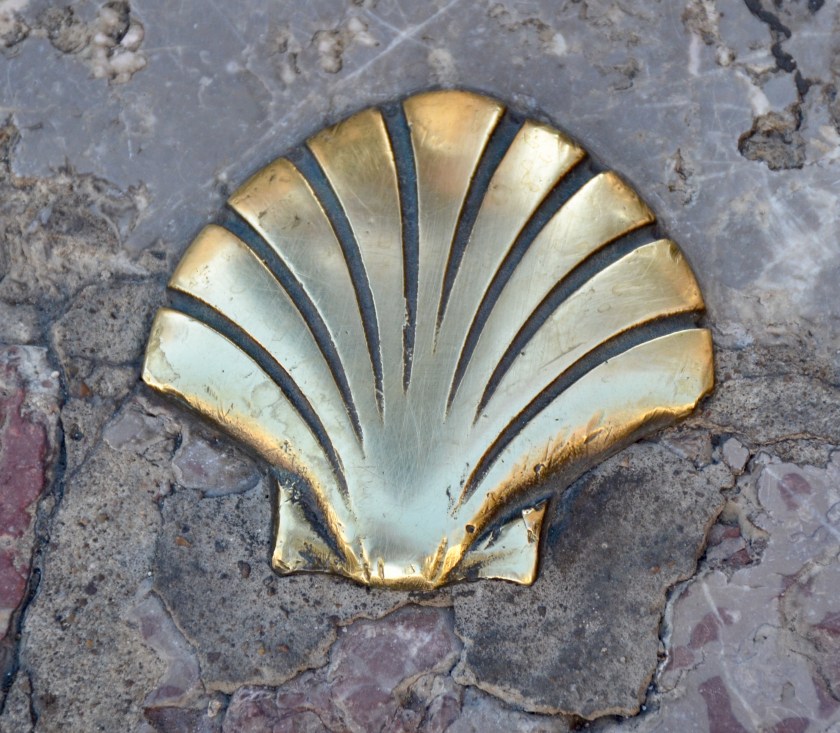
A scallop shell, embedded in the road and burnished by hundreds of thousands of footsteps, pointing the way to Santiago
Welcome to what I expect will be my final blog post. Since I started this blog I have been wondering about what I could and would write in this final section. There are really 2 sections: Spain in general and our Camino walk. Before we arrived, I expected the Camino to just be part of a larger adventure in Spain. But now it feels that not only were they separate events, but that the Camino was the headline event with the rest of our trip fitting around out Camino experience. I don’t know if that makes sense!
Spain – in general
We love Spain! I will always think of Spain as warm and sunny, even though some parts are supposed to receive many days of rain a year. Sadly, the wonderful weather we enjoyed means much of Spain is in drought. People were concerned about poor crops; large forest fires have ignited in Galicia and Portugal and there are reports that the grape harvest and wine production have been severely downgraded. We were lucky to travel through different regions and landscapes and through farmland, villages, towns and cities. We saw how people lived and made their living. We saw the verdant coastline and the drier interior and how the people, culture and architecture changed as we moved through these places.
We met wonderful, friendly people who were willing to help us and to engage in discussions about history, politics, religion and about all of Australia’s extremely dangerous animals. We had fantastic food – pintxos in San Sebastien, tapas in Madrid, amazing seafood, suckling pig and lamb, oxtail stew, bread and olive oil, pizza at La Fabbrica and of course, Jose’s salads! Then there was the wonderful wine everywhere! There was nothing I did not like. It’s sad to see the impact of international terrorism on a country that is increasingly dependent on tourism. The outcome of the Catalan independence movement could also have a detrimental effect, especially if it sparks similar movements in other parts of the country. We will just have to hope for the best and plan to return in the future.
The Camino
I thoroughly enjoyed our Camino experience. Nancy and Jose excelled in combining the physical challenge with the historical, cultural, social and economic contexts. I loved the sense of history and thinking that I was following the footsteps of people who lived hundreds and even thousands of years ago. Other walkers were unaware of many of the places, events and personalities we learned about and I am very happy we decided to do the Camino with Nancy and Jose from On Foot in Spain and I thoroughly recommend them https://www.onfootinspain.com/tours/.
In my first post I pondered two questions. 1) How I, as an atheist, came to be doing a walk on the Camino de Santiago, one of the world’s major pilgrimage trails? 2) What is an authentic Camino and would ours be authentic? Once we started, these questions changed in importance. I certainly didn’t find God or have a spiritual reawakening (we are still waiting for John to have his epiphany, messy or otherwise) and no-one in our group was overtly devout. In fact, most expressed scepticism about religion in general and the Catholic Church in particular. If anything, I became even more cynical. After seeing the enormous wealth and opulence on display in the cathedrals it’s easy to see why the Reformation started in the 16th century and why the Catholic Church is struggling to remain relevant in Europe and other traditionally Christian countries such as Australia.
We discussed the relevance of religion with two of our post-Camino guides. While our extremely sceptical Toledo guide still believes there is a “higher power”, she thinks the Catholic church is only interested in perpetuating itself which it does by maintaining its power over people and increasing its wealth. Why, she asked, would anyone with an education enter the church for a life of celibacy and limited life experiences? Our guide in Cordoba, self-described as a non-practicing Catholic, agreed. The Church was losing relevance for young educated Spaniards who wanted to travel and build careers. Her mother attends church regularly to pray for her children. Our guide hadn’t realised the irony of her mother praying to the Christian God for her daughter to gain accreditation to take tourists through the Mesquite (Mosque) until I pointed it out!
On the other hand, there were many devout people attending the Pilgrims’ mass in the Cathedral in Santiago, with a confessional operating behind us throughout the proceedings, showing that the church retains significant power over people. It will be interesting to see how the Church deals with current scandals such a paedophilia by priests and child abuse in its orphanages and whether it will ever allow priests and nuns to marry to attract more people to religious roles. Or will it move its focus to developing countries in Asia, Africa and South America where it still has a stranglehold? The ascension this week of Chinese President Xi Jinping to a similar status as Mao Zedong must be sending shockwaves through the Chinese Christian community, predicted to have the largest number of Christians in the world by 2030 (http://www.telegraph.co.uk/news/worldnews/asia/china/10776023/China-on-course-to-become-worlds-most-Christian-nation-within-15-years.html) as his policies signal a return to those of the Mao era when Christians were persecuted.
Secondly, I pondered whether our Camino, in which we walked selected sections and stayed in hotels rather than refuges, would be less authentic than that of someone who walked 799km. We unreservedly admired people laden with full backpacks for their stamina and motivation. We were very glad we were only carrying daypacks and were bussed through less attractive sections, the outer suburbs of towns and where the path was on the road. And that we had Jose’s lunch to look forward to every day. On the other hand, walkers who walk the final 100km to Santiago continuously are entitled to receive their compostella, meaning that even though we had walked 160km, 60km more than these walkers, we were not eligible for a compostella (something we knew before we started).
Nancy explained that until the recent incarnation of the Camino (the 1970s or so) the objective of the pilgrimage was to get to Santiago. It did not matter how you travelled, as long as you arrived and until the 20th century, the only ways of reaching Santiago were on foot or by pack animal. Nancy explained that everyone’s Camino is different and that no matter how much you do or how you do it, it is still your Camino. I am happy with this, I am proud of what I achieved and I congratulate those who walked 799kms. And, there is still a small me inside that thinks about walking that 799km!
Finally, how would I describe the Camino? Is it just another walk, like other famous long distance hikes and treks, or is there an additional, unique quality? While my experience of other treks is limited to only one other so I cannot answer this question authoritatively, one quality I observed was the sense of community, within our group, with other walkers and more widely, through space and time. We were lucky to be walking with a group that connected immediately. We spent a lot of time together in the bus, over meals and on the trail. The sense of community was also strong when we talked to others in bars, waiting for toilets or while walking. Questions about where we were from, where and when we started and how much time we had to do Camino were common. I remember being cheered on by a group of walkers sitting in a bar as we crossed a bridge into the town where we were staying for the night.
There was also a sense of community between the walkers and the people who lived and worked along the way, such as the bars, refuges and hotels. Walkers and business owners are interdependent – each relies on the other. Walkers need the businesses for consumables, food and refreshments, toilets, accommodation and to have their Camino passports stamped if they want their compostella. The businesses need the walkers to make a living. In the age of social media, with Facebook pages linking walkers at different stages of the Camino, it is critical for businesses to make a good impression on walkers who have the power to recommend some places over others to those following. Many businesses displayed the “Like us on Facebook” logo.
The concept of community across time is interesting. In the short-term, walkers transit along the Camino at different times and at different speeds, but almost always traveling from east to west (at least on the French Way). Fabia Tory, in “A book of not forgetting”, walked with some people for a while, then with others or by herself, later reconnecting with people with whom she had walked previously. She was joyous when she met up with old walking mates at the Pilgrims’ Mass in Santiago. Nancy Frey, in “Pilgrim Stories”, discussed the role of Camino groups in helping people readjust to post-Camino life. Since then numerous Facebook pages have been started to connect people, not only over space from different parts of the world, but also over time, connecting people who have finished with those at different stages of their journey and those yet to walk. They have shared interests and experiences that are unique to Camino walkers and by forming a community, can discuss their experiences, navigate difficulties settling back into their lives and potentially build long-term connections and friendships. The sense of community is also enabled by the symbolic cockle shell and yellow arrows, available along the way as keyrings, patches, fridge magnets and on items of clothing and as jewellery will serve to identify pilgrims when their paths cross at any time in the future.
I also a sensed a community extending over a longer timeframe. It was not difficult to imagine I was walking in the footsteps of pilgrims who preceded me by up to a thousand years, to imagine the way they travelled, the clothes they wore and the hardships they endured and to identify with them. This was especially the case when we visited 11th century towns like Puente la Reina that had been established specifically to cater to pilgrims. While backwards communication with the deceased, of course, is impossible, forward communication occurs in the form of: guidebooks such as “Codex Caliixtinus” dating as far back as the 12th century and numerous more recent guides; novels such as “Strong as death”, a murder mystery set in the 12th century, by Sharan Newman (1996, Forge) and “The Pilgrimage” by Paulo Coellho (1987, Thorsons); there are various histories of St James and the Camino available as well as autobiographies by famous and non-famous people about their Camino experiences. From such resources, potential walkers can learn something about the people who have walked before them, the historical background and what to expect as well as enabling them to identify with a community spanning a millennium. Is this different to other long distance treks and hikes? I guess there is only one way to find out!
I think this probably brings me to the end of my blog. The Camino, our time in Spain and writing this blog have all been great experiences. I would like to thank Nancy and Jose from On Foot in Spain https://www.onfootinspain.com/tours/ and all of our fellow travellers! We had a blast! And maybe I have inspired someone to do the same!!
Our hotel in Cordoba was a short walk from the restaurants and old town and as soon as we checked in we began to explore. We were soon wandering along cobbled roads and alleyways, with glimpses into cool, relaxing courtyards, decorated with Muslim style ceramics, palms and other plants and sometimes water features. Houses in this part of Spain have been built around internal courtyards such as these for centuries. Even walking past them and glimpsing them through doors and windows gave a sense of peace and safety from the outside world. Since it was the eve of a national holiday, the cafes and shops were busy with Spanish holidaymakers. We made our way down to the old bridge, originally built by the Romans, from where we could see the remains of some old mills and a water wheel and listen to buskers playing traditional music. Even though we were now in Andalusia, the lure of Galician seafood was too strong (rationalising that we had 3 nights in Cordoba, so plenty of time to sample the local delicacies) and we had a great meal of octopus and beef. Once again, the lack of a common language was not a problem with the very genial chef helping us to order.
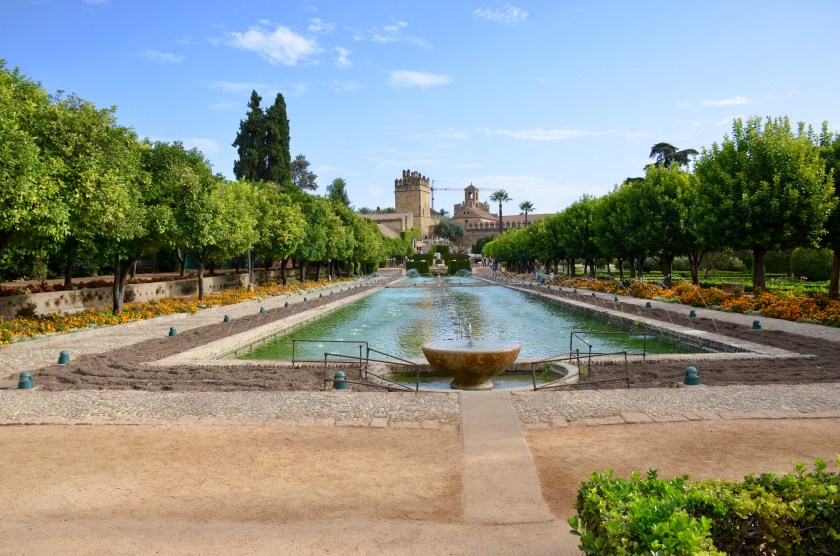
Originally, we had planned to visit Alhambra while we were in Cordoba. However, tickets had sold out long ago, probably because of the national holiday, so instead, we found a guide for a full day tour of Cordoba for the following day and bought train tickets for a day trip to Seville for the day after that. Our tour of Cordoba started with a visit to Alcazar de los Reyes Cristianos, translated as “Castle of the Christian Monarchs”, which dates to the Visigoths. It was occupied by the Umayyad Caliphate during the Muslim conquest and then re-occupied by Christians during the Reconquista in the 13th century and rebuilt by Alfonso XI of Castile in 1328. Later, the castle was used by the tribunal for the Spanish Inquisition (https://en.wikipedia.org/wiki/Alcázar_de_los_Reyes_Cristianos). As well as displays from the Visigoth, Muslim and Christin periods, there were also Roman artefacts on display including an intricately carved coffin and some mosaics. We later walked through the manicured formal gardens of the Alcazar, admiring plants and the timeless designs of the different sections.
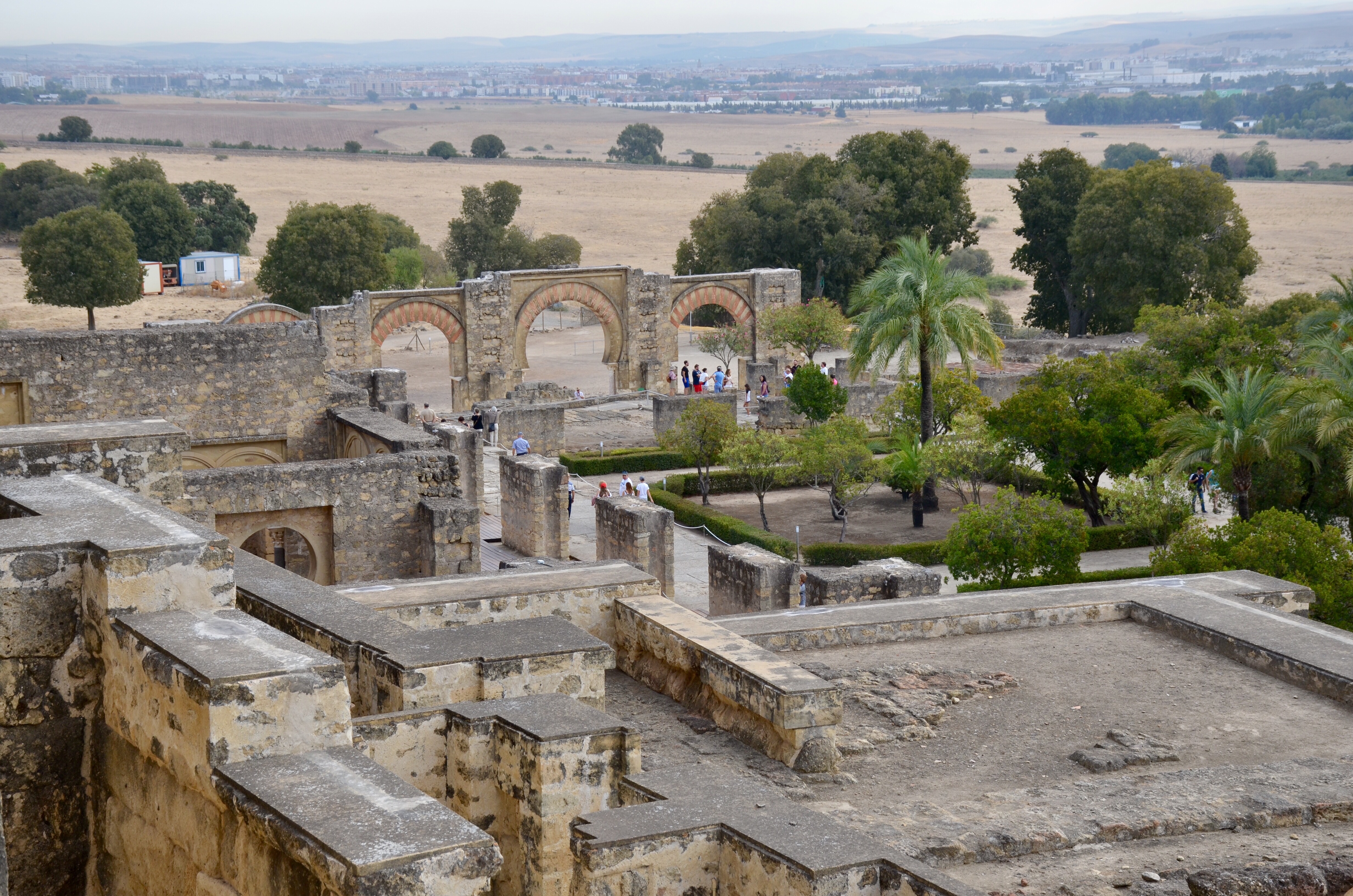
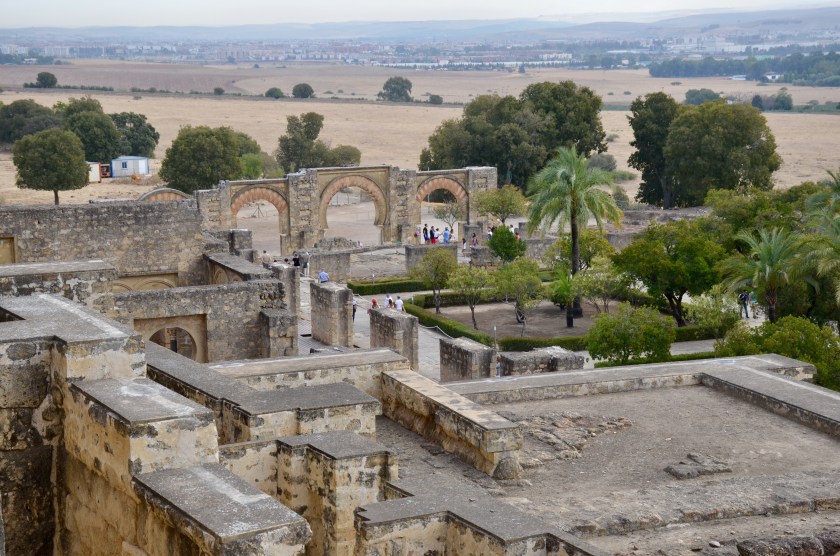
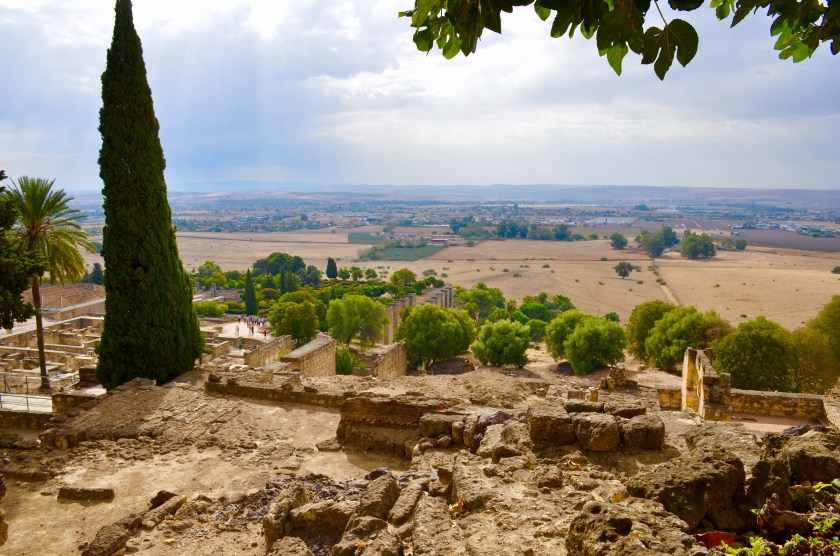
We caught a taxi to our next stop, the active archaeological site at Madinat al-Zahra, a few kms outside Cordoba. Madinat al-Zahra is the ruins of a city constructed by Abderraman III the first Caliph of Al-Andalus in 936 (http://www.andalucia.org/en/cultural-tourism/visits/cordoba/museum/conjunto-arqueologico-medina-azahara/). We wandered around the mostly reconstructed city and visited the on-site museum to watch a video showing what life would have been like in the city in the 10th and 11th centuries.
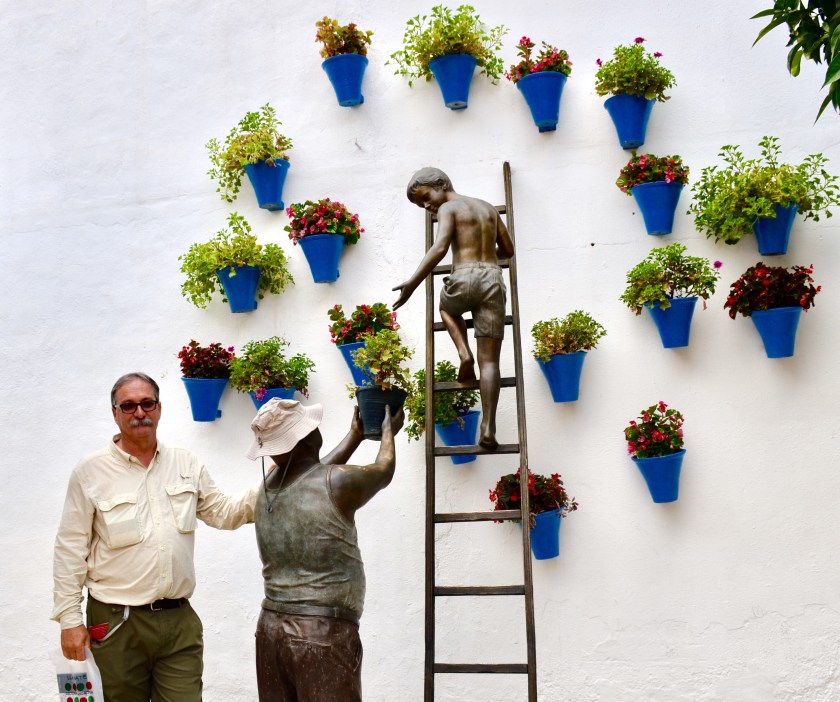
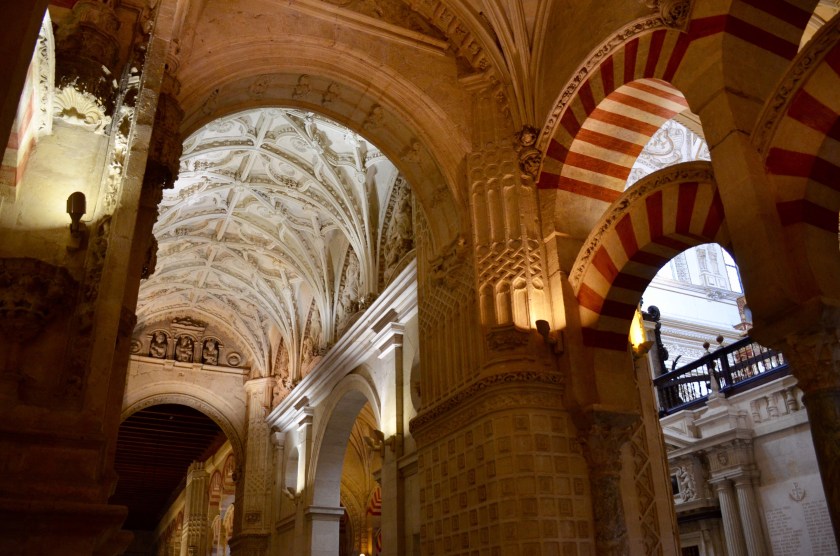
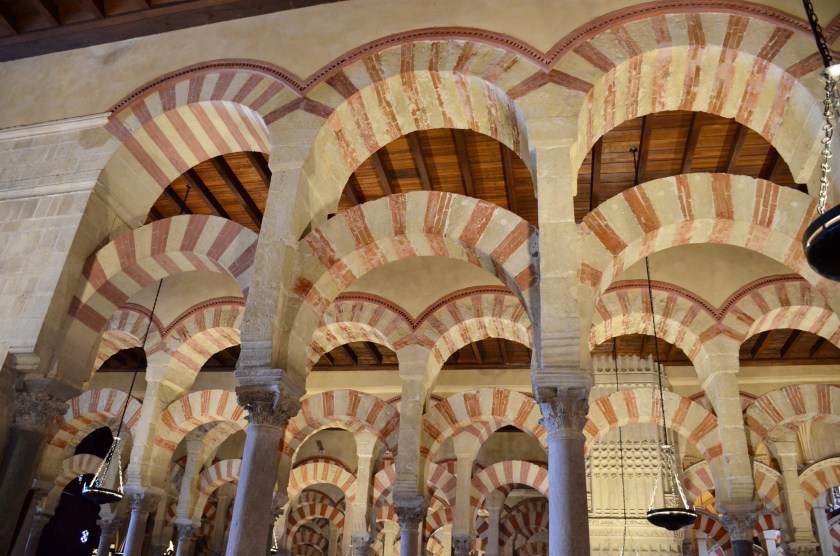
Our taxi then dropped us back in Cordoba and we walked to the remarkable Mezquita-Catedral de Córdoba. The Mesquita, which features a Rennaisance cathedral inside a Medieval mosque, is believed to stand on the site of an early middle ages Visigoth church which was demolished in 784 to make way for the construction of the Great Mosque, which was extended numerous times during the Muslim period before the Christian Reconquista when the centre was converted to a cathedral https://en.wikipedia.org/wiki/Mosque–Cathedral_of_Córdoba). As we walked around the enormous interior, our guide pointed out the different architectural styles, indicating extensions and changes to the building. We lunched at one of our guide’s favourite restaurants on Cordoban specialities and finished our tour after visiting the Synagogue and wandering through the alleyways that were decorated with hanging baskets, sculptures and statues.
John ensuring the statue was sunsafe..
Hanging baskets like these lined the alleyways in CordobaThe Renaissance cathedral in the centre of the Medieval Mesquita in CordobaThe Muslim arches that were throughout the Mesquita in CordobaThe archaeological remains at Madinat Al-Zahra, CordobaThe archaeological remains at Madinat Al-Zahra, CordobaA formal water feature at Alcazar de los Reyes Cristianos, CordobaA Roman mosaic displayed at Alcazar de los Reyes CristianosA marble Roman casket displayed at Alcazar de los Reyes Cristianos
Seville
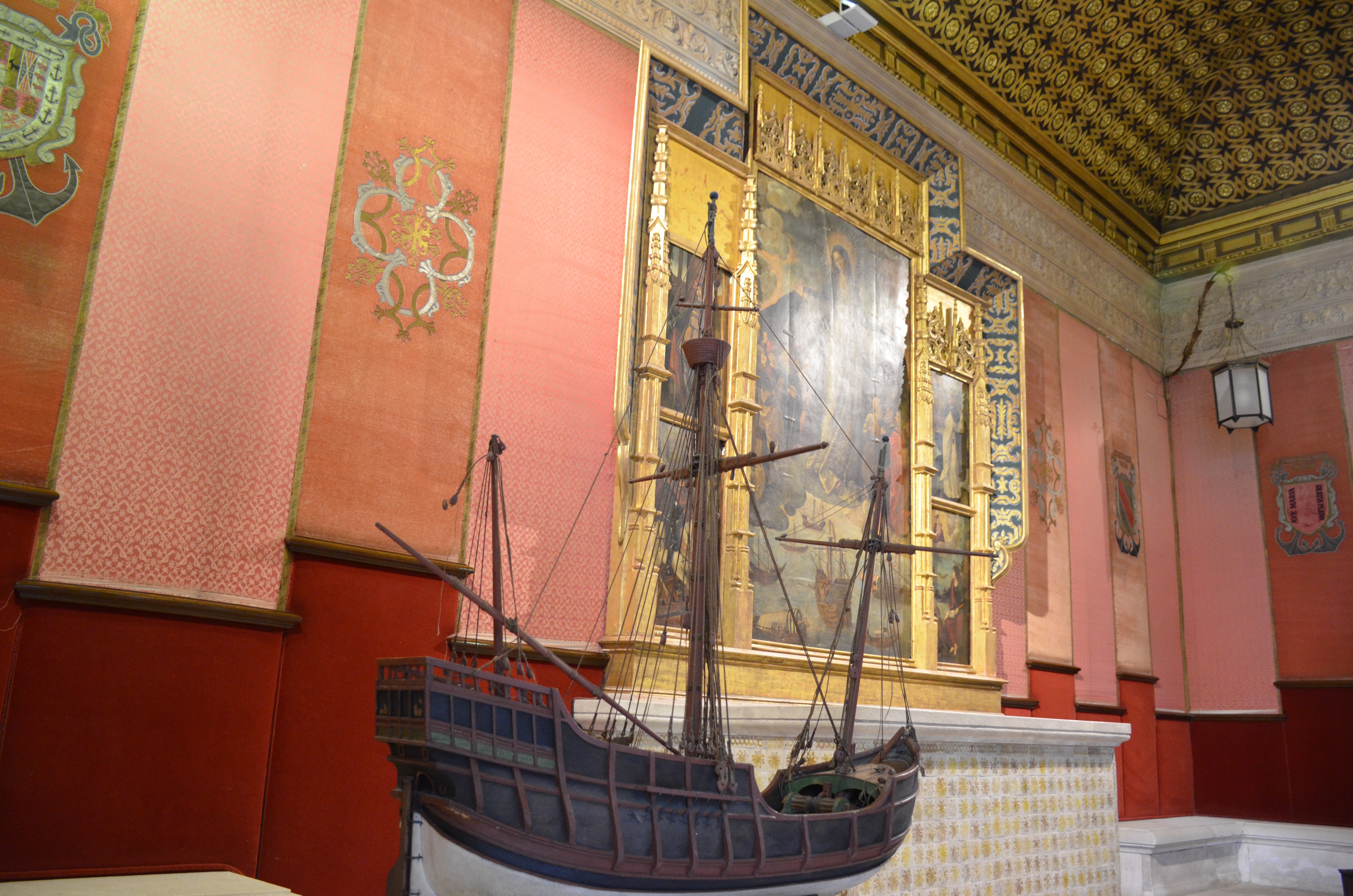
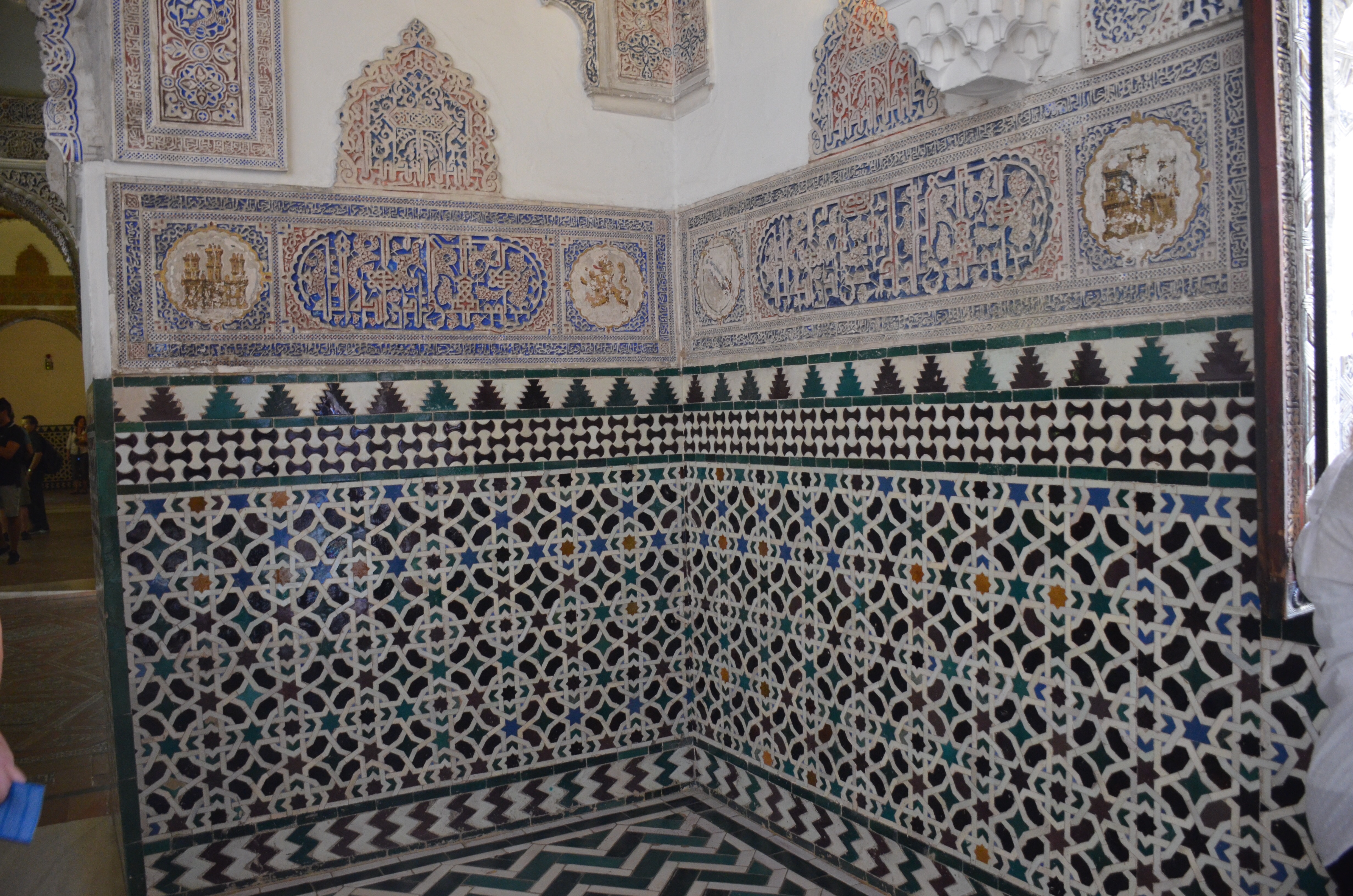
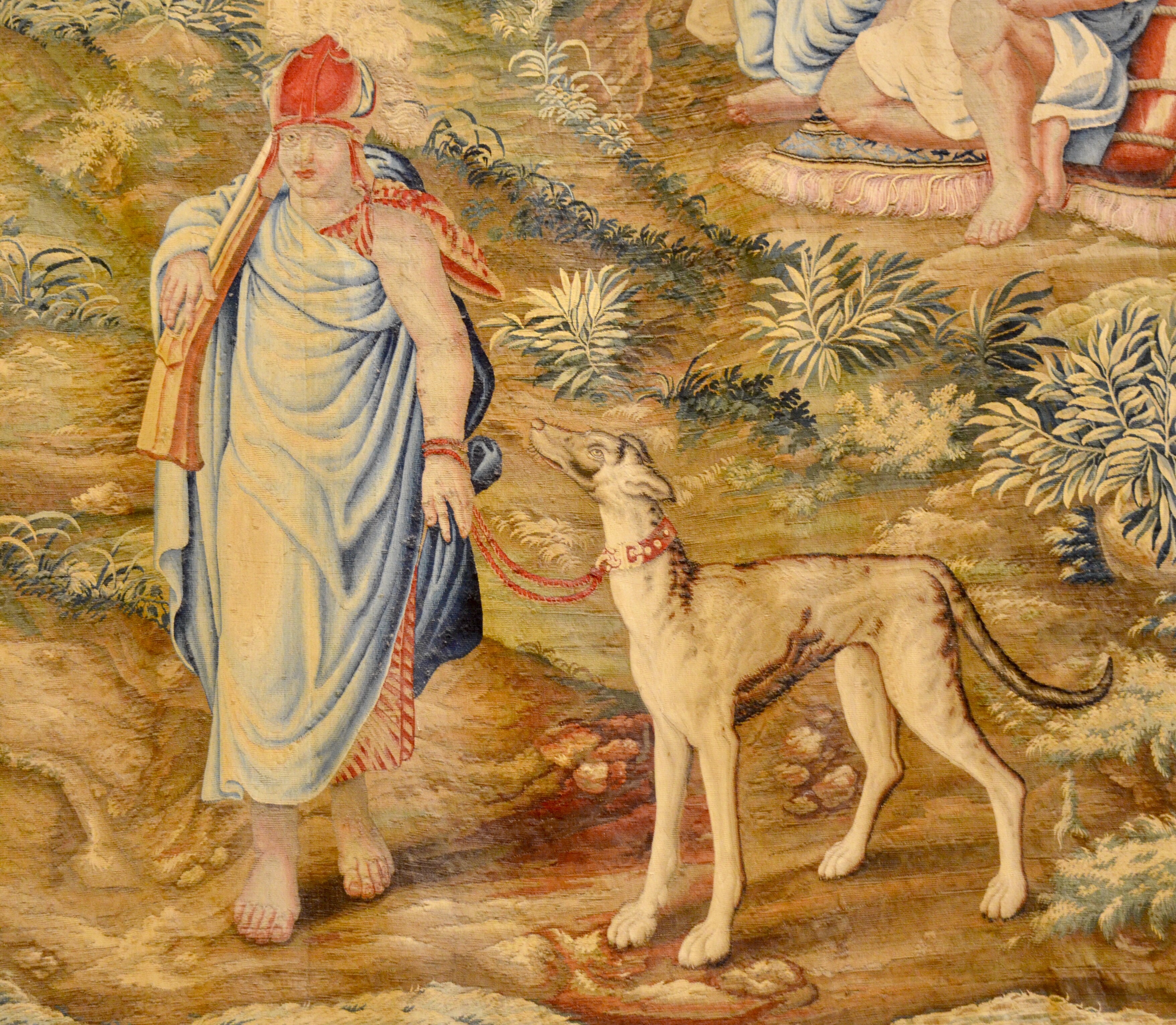
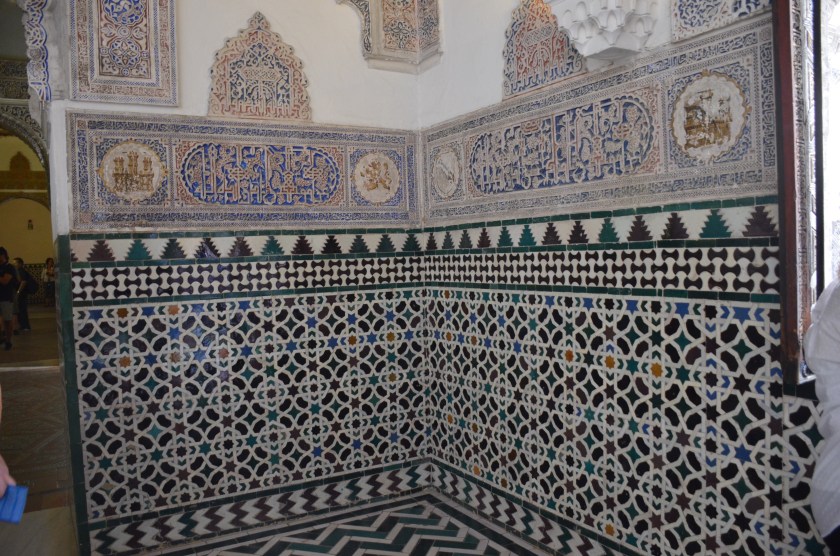
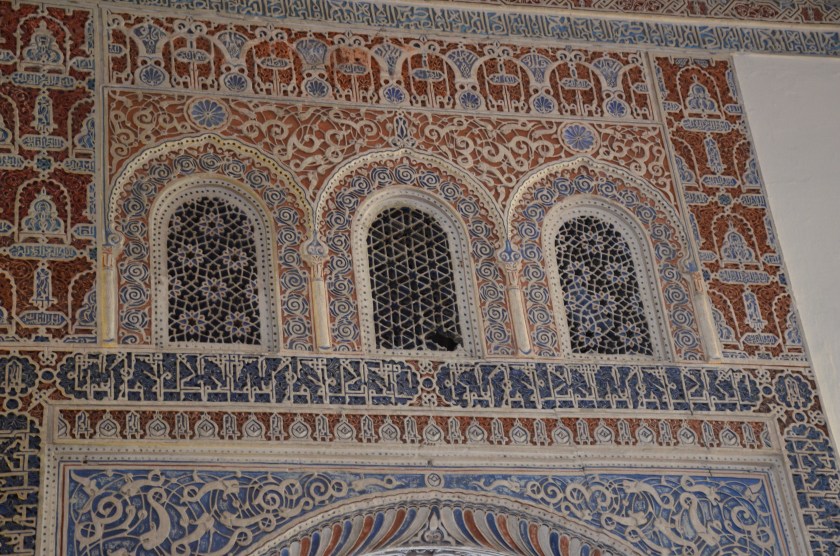
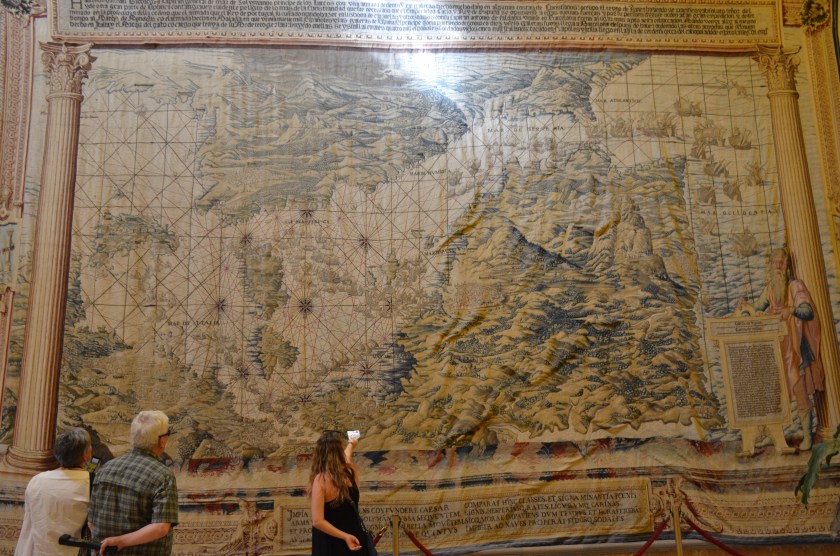
The next day, we caught the train to Seville to visit Real Alcazar de Sevilla. The Alcazar was built as a Royal Palace during the Muslim period and has been used continuously since, with the current Spanish royal family still maintaining apartments. It was designated as a UNESCO world heritage site in 1987 and is one of the most popular tourist destinations in Spain (https://en.wikipedia.org/wiki/Alcázar_of_Seville). Because of the continuity in occupation, the palace has been perfectly preserved and maintained. Many of the buildings retain their original designs and décor including Muslim ceramics, some dating to the Muslim period. Enormous, fascinating Flemish tapestries and paintings adorn the walls in other rooms. It would be impossible to not be impressed with the grandeur of the Alcazar. The gardens are also spectacular, with beautiful formal and informal sections and water features. We then headed back to the station, stopping to look at the Metropol Parasol, the world’s largest wooden building (at the time of the article we consulted). We were unable to find the entrance, but from the outside it looked like hundreds of balsa wood planes had been interlocked.
Celebrating Spain’s time as the pre-eminent maritime nation in the 15th century, Alcazar, SevilleGorgeous ceramics, Alcazar, SevilleGorgeous ceramics, Alcazar, SevilleOld masonry walls, Alcazar SevilleOne of the Flemish tapestries on display at Alcazar Seville. It took us a while to work out that in this map, North was at the bottom!A section from one of the Flemish tapestries, Alcazar SevilleA section from one of the Flemish tapestries, Alcazar SevilleThe world’s largest wooden structure, Metropol Parasol, Seville
Back to Cordoba
We had booked train tickets for the next afternoon to Madrid, connecting to Barcelona, from where we would start our return journey to Australia. After checking out of the hotel we went back to the old town of Cordoba to look around one last time and to do some shopping. When we were on the train from Madrid a few days before we had met the owners of a pizza restaurant and we decided to go there for lunch. John had looked their restaurant up and found that it was very highly rated. Our walk took us out of the old town and away from the tourist strip. The owners greeted us with delight when we arrived! The restaurant, La Fabbrica, was divided into sections, with each decorated differently. The section we sat in had a tropical theme, complete with bright pink flamingos. There was a great atmosphere, with catchy background music in the that wasn’t too loud to prevent conversation. As we ate (a wonderful gorgonzola and pear pizza and an interesting salad) the place filled up with local families enjoying time together and a good meal. It was a great way to end our visit to Cordoba!
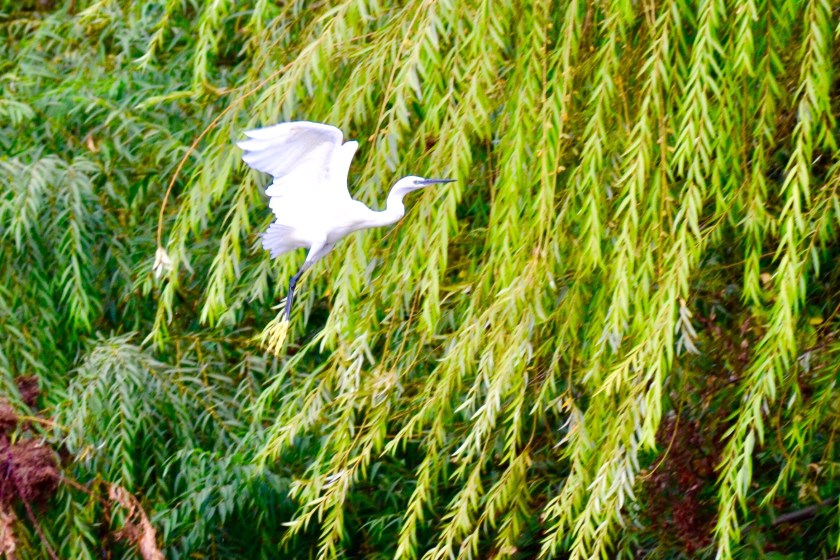
John finding a rock shop, CordobaA heron taking flight, CordobaLooking towards the old town of Cordoba
Barcelona
Once again, the trains were very comfortable and once again we wondered if such a service could operate profitably in Australia. We arrived in Barcelona just before midnight and walked to our hotel, only 5 minutes away. We had only allocated one day to Barcelona because of the ongoing political instability caused by the call for Catalan independence from Spain. Since we had been in Spain, we had seen reports about mass protest rallies, both for and against independence, in the centre of Barcelona. We didn’t want to become caught up in a rally or have our plans disrupted. On top of that, our late arrival meant we were tired and we also had to pack our bags for a 6am flight the following day. That didn’t leave us much time to see Barcelona!
After breakfast we caught a taxi to Las Ramblas, the main tourist strip in Barcelona and also the site of the recent terrorist attack, where a van was deliberately driven into pedestrians. It was obvious that the authorities remained on high alert with a strong police presence on motorbikes, heavily armed on foot and vigilant in cars. As we walked towards the harbour, the concentration of tourists increased rapidly. Although we had always been with other tourists since we arrived, this was on an entirely different scale! To escape, we went into the Maritime Museum, which is on the site of the 13th century shipyards which drove Barcelona’s supremacy in the Mediterranean during the Middle Ages. The centrepiece was the full-size replica of the Real Galley, which was the flagship of Don Juan de Austria in the Battle of Lepanto in 1571. Key facts we learnt about galleys included: prisoners and slaves were shackled in place as rowers, never being released to sleep, walk around or go to the toilet; the expected lifespan of a rower was no more than 2 years and galleys stunk so much that they were could be smelled before they were seen. We then looked for a seafood restaurant for lunch at the harbour. The one we found was enormous, probably catering to cruise ship passengers. We enjoyed a good seafood paella, which we decided was a “must do” before we left Spain.
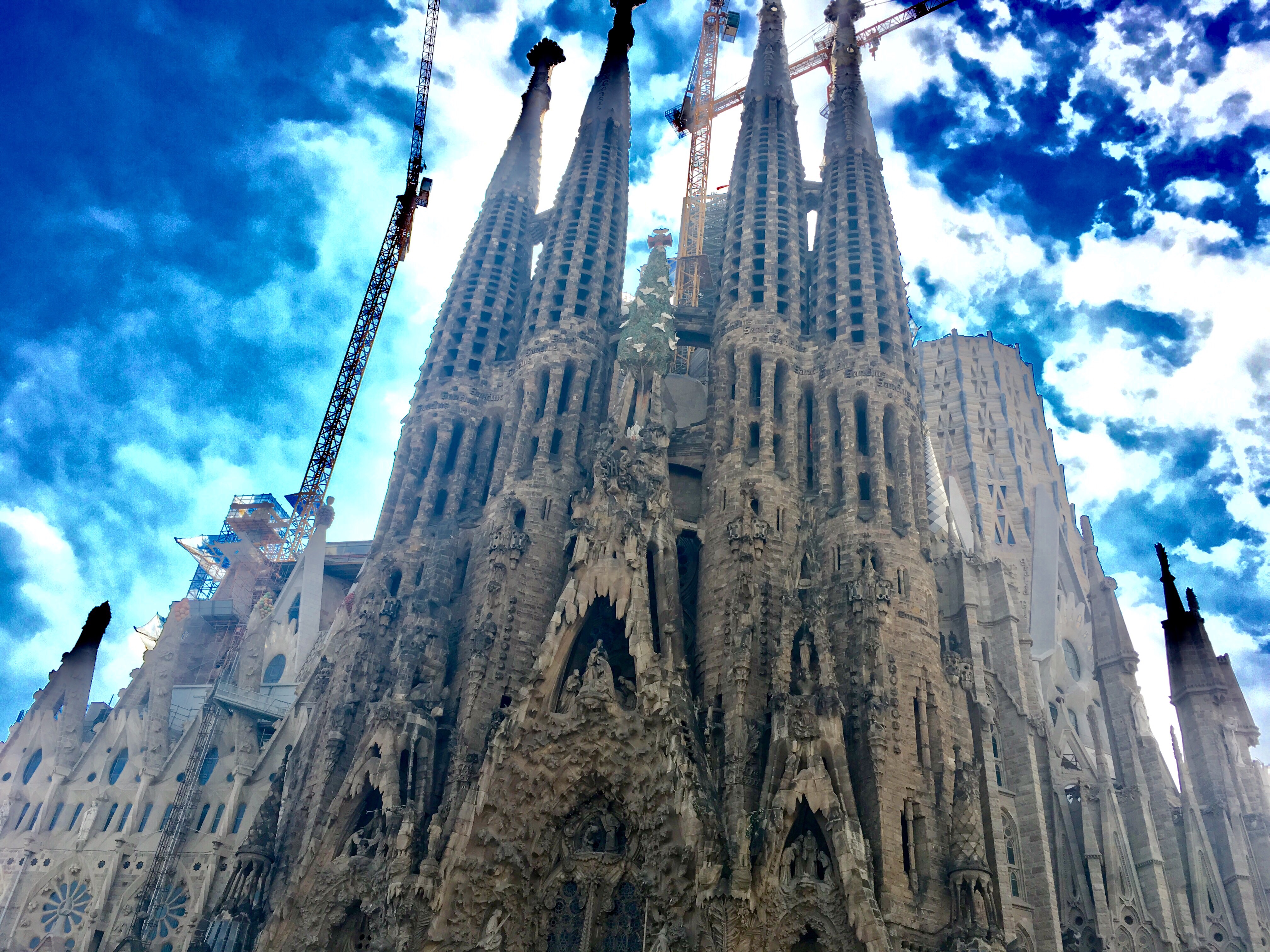
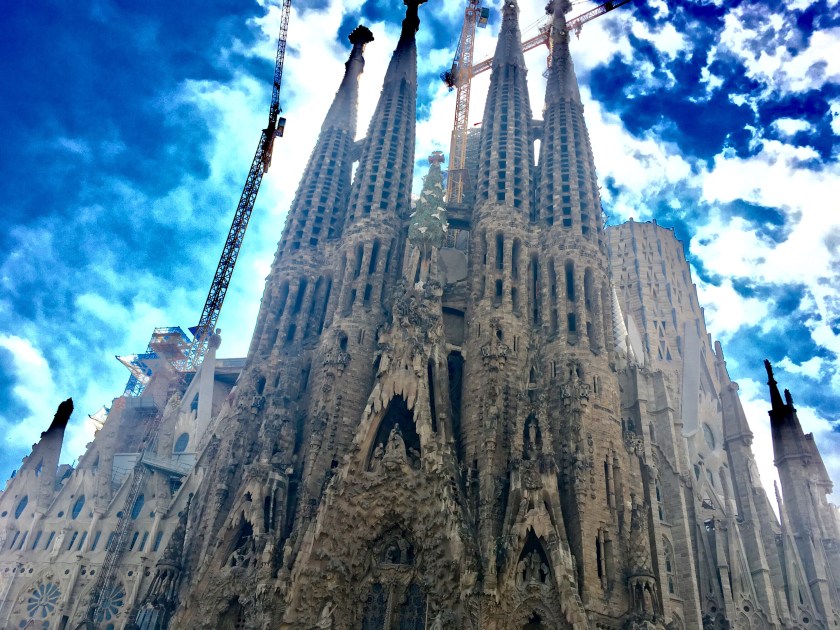
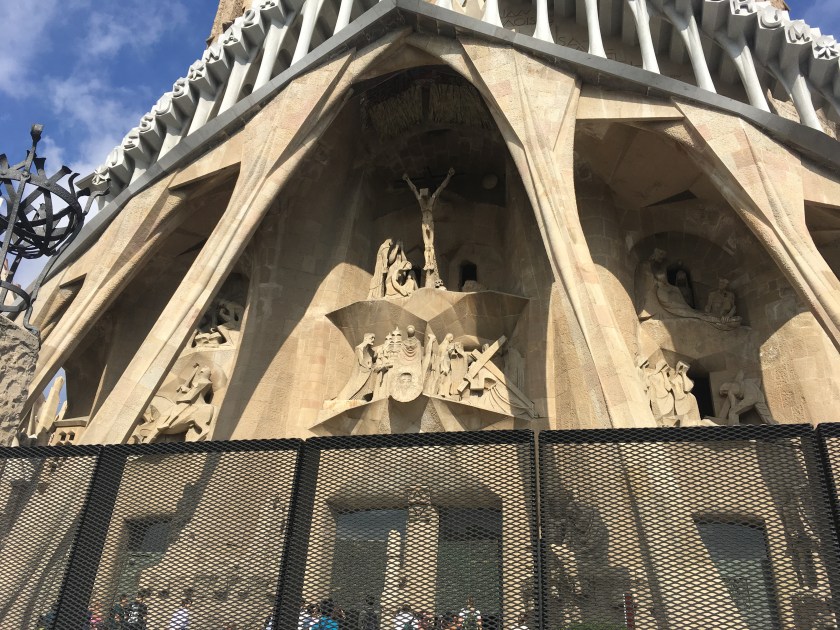
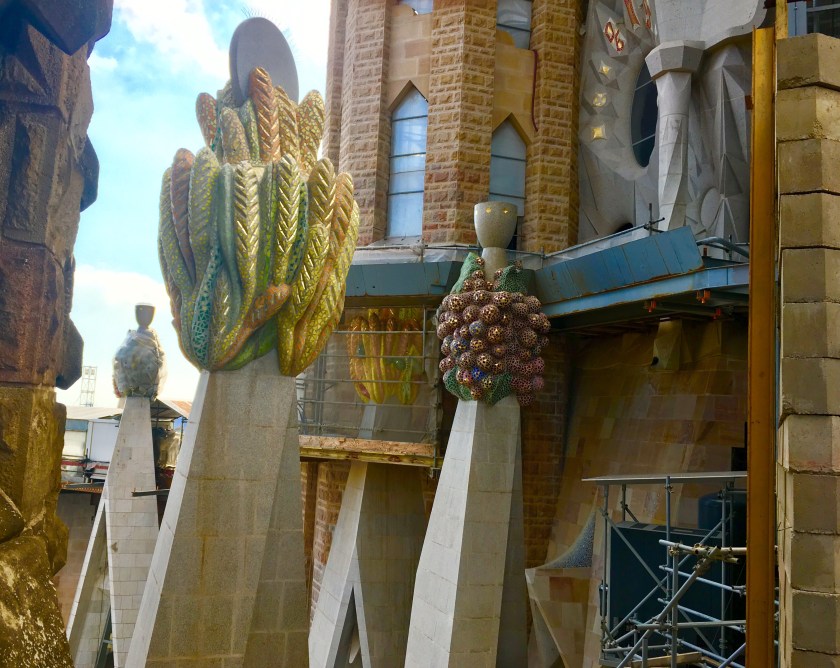
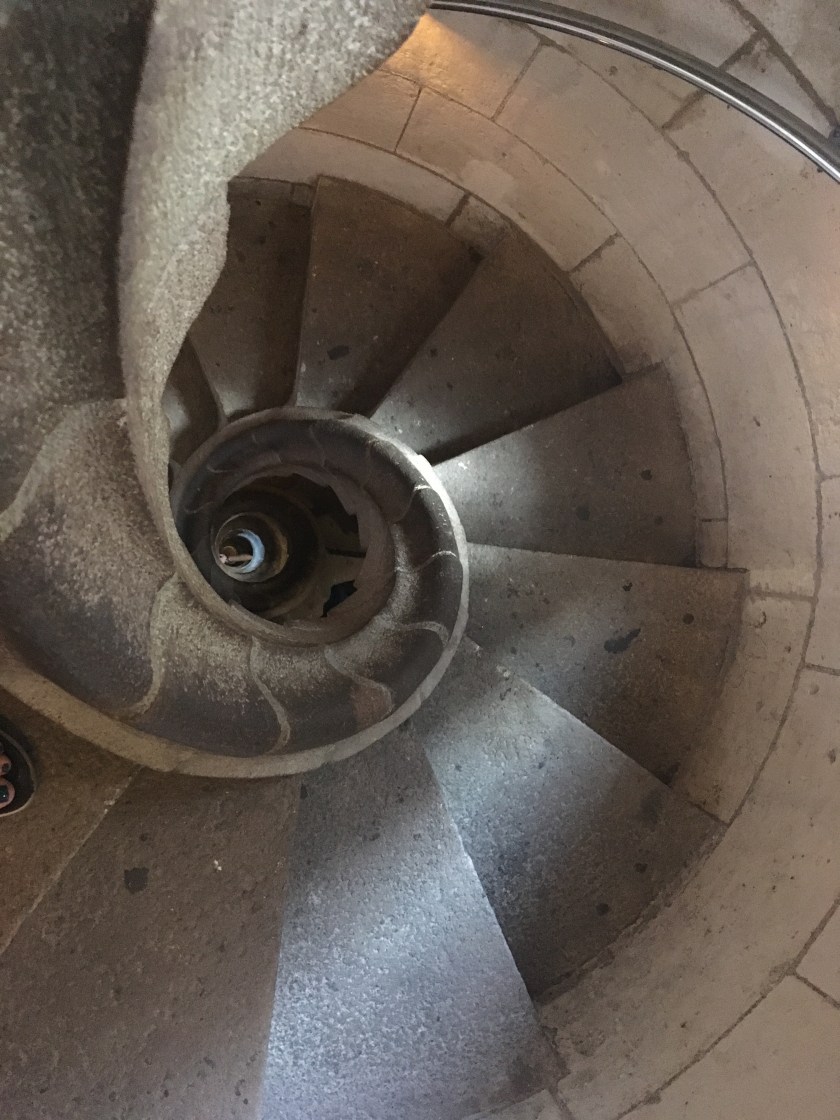
A few days beforehand, John had booked tickets to Sagrada Familia, the basilica designed by Antoni Gaudi and which has been under construction since 1882. We had seen two of Gaudi’s other buildings – the merchant’s house in Leon and the bishop’s palace in Astorga. However, neither prepared me for Sagrada Familia. From the outside, it’s towering spires and Spanish late Gothic/Catalan modernism/Art Nouveau architecture (https://en.wikipedia.org/wiki/Sagrada_Família) are awe-inspiring. Some of the spires were topped with carvings of vegetables and other parts looked like Christmas decorations, although I’m sure they had a more serious meaning. After touring several cathedrals on the Camino, at first sight the Sagrada Familia looked almost like a caricature (at least to me, I willingly admit I have absolutely no knowledge of art or architecture). However, once inside, we could identify the familiar spaces we had seen in the older cathedrals. The glorious red, orange, yellow, green and blue stained glass windows signified the seasons and the huge pillars, of different types of stone, signified the forest. The inside was light and airy, certainly different from the dark Romanesque and Gothic cathedrals we had seen earlier. John had also booked tickets to go up one of the towers. From the top we gained a different perspective of the outside of the building. It is magnificent! Like the other cathedrals, Sagrada Familia made me think of Ken Follet’s book, “Pillars of the Earth” which is about the building of a cathedral in the 12th century. What awe the local people must have felt watching the cathedral grow! I must read it again!
We then returned to the hotel, eating in the restaurant because we had yet to pack and since we needed to be at the airport at 4am, we needed to go to bed early. Our last Spanish meal was excellent and we had a great view over the city from the 23rd floor. We checked out early the next morning, on our way home. We arrived as the airport was just opening. Only a couple of coffee shops were open and the biggest non-passenger presence were the armed police. It felt like a sad note on which to be leaving Spain and to end a fantastic holiday.
Now the Camino was over and we had visited Finisterre, we were starting the rest of our Spanish holiday. By the time we finished breakfast the morning after our trip to Finisterre, all our fellow Camino walkers, except for one couple, had left Santiago. A few days previously, John and I had booked air tickets to Madrid and then train tickets to Cordoba to see some of the places where the Muslims had ruled 1000 years ago. However, we weren’t due to fly out until 9.45pm, so we had the day to explore Santiago and do some shopping.
John and I had admired Nancy’s jet scallop shell pendant, symbolising the Camino. Jet is a form of coal with a high resin content which makes it harder and more solid and possible to carve without crumbling compared to coal. Sometimes it is referred to as black amber http://geology.com/gemstones/jet/. We had no trouble finding a pendant with matching earrings, but the geologist in John wanted one of the large uncut samples displayed with the jewellery. However, none were for sale and he had to be satisfied with a couple of small samples.
We bought some small gifts and then walked to Alameda Park where key attractions include four enormous Tasmanian Bluegums planted in 1848, the first outside Australia. Here we met our friends who were due to leave later in the afternoon. After paying homage to the trees, we returned to the old town and found a great café for lunch – more delicious Galician mussels and clams and beer of course! After they left we relaxed in the lounge of our hotel and wandered around some more until we felt we could almost eat dinner – lobster this time. Galician seafood was all I had expected and more. Super-fresh and simply cooked, it was equal or better to any seafood I have had anywhere. I need to learn how to cook it!
By the time Jose, our driver to Finisterre, arrived to take us to the airport we had seen plenty of Santiago. We were tired and struggled to stay awake on the short flight to Madrid. The hotel had upgraded us to an executive suite not much smaller than our house, but we were just grateful to fall into bed. We were meeting our guide at Toledo Station the next morning and needed to catch as much sleep as possible!
The next morning on the train to Toledo we noticed the huge difference in vegetation and landscape between this area and the verdant coastal regions we had walked through. People told us that large parts of Spain were in drought and the current run of hot weather was making conditions even dryer. Toledo, which dates to Roman times, is situated on a bend of the Tagus River and the steep cliffs provided formidable natural defences, augmented by ingeniously designed bridges and fortifications.
After the fall of the Roman Empire, Toledo became an important seat of royal and religious (Christian) power under the Visigoths. Following the Arab conquest in the 8th century, Toledo came under Muslim rule, and was the centre of numerous uprisings by rival Muslim groups and shifts in power over the next 300 years, although the Christian church and Jewish population coexisted throughout the Muslim era. In the 11th century, Alfonso VI of Castile took control of the city in the early stages of the Christian Reconquista. Initially, Christians, Muslims and Jews lived harmoniously, however, in the 15th and 16th centuries, persecution of the Jews resulted in their expulsion, forced conversion and murder (https://en.wikipedia.org/wiki/Toledo,_Spain).
Our guide was knowledgeable and refreshingly cynical about the Catholic church. While we knew that Australia is becoming increasingly secular and that the Catholic Church is struggling to attract priests and nuns, we didn’t realise it faced such problems in strong Catholic strongholds such as Spain. However, as our guide pointed out, a life of seclusion and celibacy is becoming less and less appealing to young, educated Spaniards. She also made interesting observations about the role of the confessional (a way of holding power over the confessor) and why the Catholic Church is so opposed to allowing priests and nuns to marry (not wanting to share the priest’s estate with recognised offspring).
We started the tour by driving to lookouts from where we could see the city and identify the old city walls. We then wandered around the historical and well restored Jewish quarter, visited the Mezquita-Iglesia de El Salvador, a 9th century mosque that had been converted into a Romanesque church, some Roman ruins discovered by a homeowner excavating to build a garage and the Roman Medieval Bridges. After the tour we had yet another delicious lunch (steak & partridge) and then went shopping. We bought some Damascus steel knives for which Toledo is famous and looked through a fascinating pottery shop that extended underground into the old passages that the Jews used to evade their persecutors. We would have bought some pottery if we had room to take it home. We accidentally arrived back at the station an hour before our train, so we had time to sit in the garden at the station bar and have a wine. Once back in Madrid, we went to a small restaurant across the road from the hotel for dinner. It seems excellent food is available everywhere in Spain!
We had planned to visit the Prado Museum the next morning before catching an afternoon train to Cordoba. However, the heightened threat of terrorism in Spain means that all bags are scanned for weapons before boarding trains. We were warned by the shop in Toledo where we had bought the knives that we would need to provide documentation for them every time we travelled by train. While we didn’t have trouble returning from Toledo where tourists who had purchased knives would be commonplace, we were concerned that we might have trouble on other routes – we still had 3 train trips booked. So we decided to post the knives home and by the time we had done that we had run out of time, so we didn’t make the Prado.. Maybe next time!
The train trip to Cordoba was very pleasant, we were even served a 3-course meal, complete with wine. We walked to our hotel and then took our first foray into the historic town of Cordoba… To be continued!
Close up of one of the Tasmanian Blue Gums (eucalypts) in Alameda Park, Santiago
One of 4 huge Tasmanian Blue Gums in Alameda Park, Santiago
The closed convent where nuns live, isolated from the outside world
One of the Tasmanian Blue Gums (eucalypts) in Alameda Park, seen from the plaza
Looking out over Toledo
Remnants of the Roman Bridge, Toledo
The Medieval Bridge, Toledo
The old Jewishquarter, Toledo
Looking at the Toledo Cathedral through narrow alleyways
Finisterre… When we first decided to come to Spain to do the Camino I discovered there is an extra stage that is not officially part of the Camino, but which many walkers do after reaching Santiago de Compostela. Some symbolically burn their walking clothes to signify the end of the pilgrimage. The story goes that St James, or Santiago as he is known in Spain, had a few behaviour management issues and, even worse, had collected only a few converts. As punishment, he was banished to “the end of the earth” to convert the heathen. So he set out towards the west and ended up at Finisterre – “finis” – end; “terre” – world – on the north West Point of the Iberian Peninsula, in what is now Galicia. This translation now gives special meaning to the Finisterre Range, on the Huon Peninsula in PNG – was it named after Finisterre, Galicia or because early explorers thought they had found the end of the world? My sources described a spectacular coastline, as well as wonderful seafood restaurants, so I decided that we should go to Finisterre on the day after we arrived in Santiago.
Nancy arranged a driver and recommended a seafood restaurant and on the Sunday morning five of us set out for Finisterre. Our driver, also Jose, had grown up in London. He was very friendly, knowledgeable and had a very British accent. He was a very good driver and his minibus was very comfortable! We hope we were in for a great day! We were all happy and felt a sense of great accomplishment after our walk. I could even describe our mood as euphoric!
The drive did not disappoint. The coastline was even more beautiful than I expected. To start with we drove through farmland and more Tassie blue gums. Then we hit the coast and drove through picture postcard fishing villages. We stopped a couple of times for coffee and to look around. Then we reached Finisterre! Unbeknownst to the others, John had chilled the bottle of Rose that we had bought way back on day 3 at the winery tour (with the gorgeous Jesus – described in an earlier post). As we arrived we realised we needed glasses, so we bought some souvenir shot glasses to toast our success. It wasn’t until after we parked and were walking out to the cliff face that we realised we didn’t have a corkscrew. However we found we had the only bottle of wine with a screw top that we’d seen in all of our travels in Spain! Surely a sign celebrating our success! After toasting our success and having several shot glasses of Rose we threw some pebbles into the Atlantic and took some photos.
The next stop was lunch at the restaurant that Nancy had recommended. The place was very busy so the only available table was in the bar. They gave us the menus which were only in Spanish and none of the staff spoke English so we really had no idea what was on offer. In the end the very patient waiter brought us one of each type of clam on the entrée menu and took us into the kitchen to see the fish to choose. We ordered clams & a fish, but weren’t sure whether we were getting 1 fish or 4! The clams were fantastic, especially the razor clams. And only one large fish arrived, cooked over coals & it was magnificent, especially washed down with some excellent vino blanco. It was truly a delicious, wonderful, fantastic meal and one that I’m sure the five of us will always remember.
After lunch we walked on the beach out the front of the restaurant and I took some more photos – of course. Then it was time to head back to Santiago. We stopped at an old bridge and mill, some parts of which dated back to the Romans. The day was the most perfect post-Camino day that I could imagine. Our euphoria increased as the day progressed and I will always think of it as a very special day spent with new friends.
Day 10 – Arzua to Pazo de Andead.
The penultimate day of our Camino walk! It’s hard to believe that we are almost finished! And sad to think that it is almost over. After breakfast we drove to the town of Arzua. These days, you must walk a consecutive 100km to Santiago de Compostela to be granted your Compostela (meaning we will not be eligible), so Nancy warned us many walkers start their journey in Arzua. This was indeed the case, with coachloads of walkers, including school and university excursions and groups of elderly walkers, hitting the trail together, some struggling on the first few ascents. We had become accustomed to seeing only a few other pilgrims, but now we were surrounded by them! The cyclists were a particular hazard with packs of them zooming through the walkers without ringing their bells to warn of their approach. We also noticed the large numbers of walkers when we stopped for refreshments at bars along the way, particularly in the lack of tables and chairs and the queues for toilets. Most bars along the Camino only have one male and one female toilet and from the start, the women in our group had been using the men’s toilet as well, but on day 10 it became a little more difficult to slip into the mens’ so we had to wait longer.
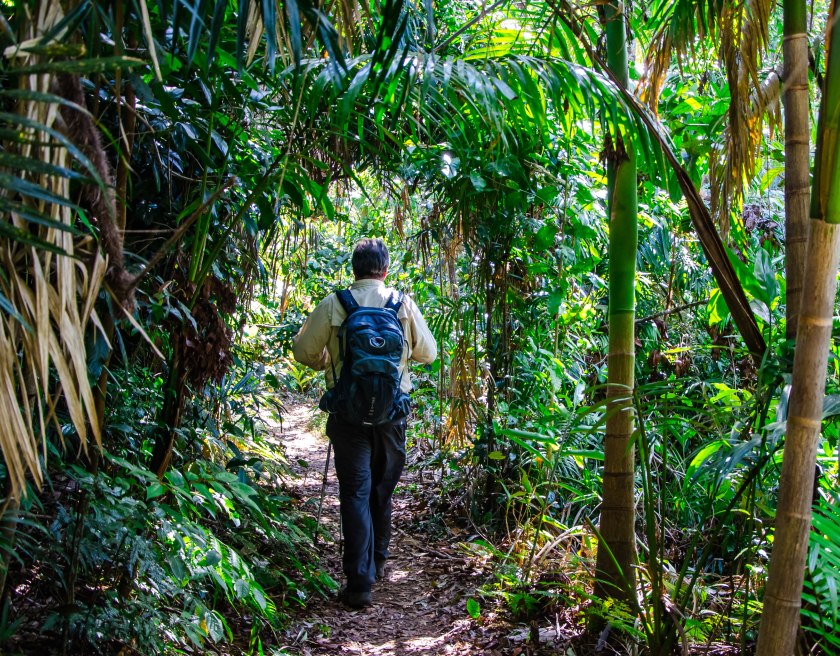
Never-the-less, we had a pleasant walk, feeling that after conquering Day 9’s ascent, we had nothing left to prove. The shaded, tree-lined trail meandered through small villages of granite buildings, dairy farms, chickens and pigs and fields of corn and cabbages. Apple trees, laden with fruit, grew along the fence line. On the Camino, anything growing on the trail can be foraged, so the trees still had apples on the farm side of the fence but none on the branches overhanging the trail. John, being a natural hunter gatherer, managed to knock a few down from the high branches (on the Camino side) to sample. Much of the path was also shaded by giant oak and chestnut trees, which Nancy explained could be a couple of centuries old. The farmers train the branches to grow straight so they could be harvested for timber without killing the tree – very sustainable, at least for small-scale harvesting.
We convened for Jose’s second last picnic, which was superb as usual.. we are going to miss his picnics! We then drove to Santa Maria de Melide, in Coruna Province, to start the afternoon’s walk. Here, the oaks and chestnuts were replaced by pines and huge plantations of Tasmanian Blue Gums which are favoured to timber because they are quick growing. At times, we felt like we were walking in Australia with the whiff of eucalyptus in the air. However, as monocultures, the plantations are probably having a devastating effect on the local fauna and flora.
At the end of the walk we drove to the wonderful Pazo de Andeade, a rural manor, set in beautiful gardens, that has been converted to a hotel by the owners. After settling in, wandering around the garden and having a few wines, we were invited into the kitchen for a cooking lesson – roast chicken and vegetables and vegetable soup. One of the most special things we have noticed are the special relationships Nancy and Jose have with the business owners, usually family owned businesses, they deal with during their tours. The owners of Pazo de Andeade greeted Nancy and Jose like old friends, which says so much about the Nancy and Jose and On Foot in Spain.
We all welcomed bed, one more day to go! We walked 19.3km for the day.
Walking into Santiago de Compostela
Lighting the incense burner
The swinging incense burner
Santiago panorama
A cheeky grotesque
A scary grotesque
Another cheeky grotesque
The cathedral, undergoing restoration
The plaza
Narrow streets of Santiago
A large oak tree
Apple trees overhanging the trail
Beautiful fields
Hand cut slate tiles
A horrendous for storing grain
The gardens at Pazo de Andeade
A beautiful hydrangea
In the garden
Day 11 – Paco de Andeade to Santiago de Compostela
Our last day! Some of us were a little reflective over a delicious country-style breakfast. We had just 8km left to walk. When we looked back at the first exhausting 8km walk at Roncesvalles on Day 1 and compared it to our nonchalant 20km on day 10, we could see how far we had come. It is conceivable that after another week we would be able to rock out 30km/day without raising a sweat!
We regretfully said goodbye to Pazo de Andeade, wishing we could come back to spend a few more nights in such a special place. We walked though some more farmland and eucalyptus forest, it was hard to believe we were only 15km from Santiago de Compestela! We rejoined the bus which drove us through the outskirts of Santiago to Rua San Pedro to walk to the Plaza de Obradoiro, the cathedral and our hotel – Hostal Reyes Catolicos, the converted Monastery and another one of the paradores – monasteries and other religious buildings converted into hotels and run by the Spanish government. The old town and the plaza were packed with a mixture of walkers, cyclists and tour coach passengers. As we walked in, we had to avoid 2 tourist “trains” – one bright red and the other white – that were dropping off and collecting passengers. It was immediately clear that the Camino and tourism in general is Santiago’s main industry.
Nancy briefed us on our options for the next couple of hours. One option was the Pilgrims’ mass which is celebrated every day at noon in the Cathedral. Otherwise we would have free time until the mass was finished. John and I tossed up what to do. We were not interested in the mass itself, but Nancy had to me out that the incense burner would be swung for this mass, which happens only on special occasions. In the end, we decided to sit through the mass to see the incense burner.
Suspended from ropes from the ceiling and using an ingenious pulley system, 4 men raise the the lit incense burner to start it swinging on a north to south axis, so high that it almost hits the roof. The burner has only come loose a couple of times through history. Once was when Catherine of Aragon, Arthur Tudor and Henry VII’s future bride, was in the cathedral. Luckily, when the rope broke the south door was open as the burner flew out the door. There is no record of whether anyone was killed or injured, but the accident was widely acknowledged as a portent of bad luck for the ill-fated princess.
We were lucky enough to find good seats, although we had a confessional box behind us with a steady stream of young women confessing their sins and leaving in tears while the mass was going. We didn’t really understand what was happening since the mass was in Spanish & we were not Catholic, but the nun had a beautiful singing voice and the devout around us were fully engaged. I loved watching their faces. Then it was time to light and swing the incense burner, and I have to admit I was impressed as it flew high above our heads. I can imagine the affect on illiterate peasants and pilgrims in the Middle Ages!
We reconvened after the mass and drove up to Monte Pedroso, overlooking Santiago for our picnic. We could clearly identify the limits of the old town and the cathedral still dominates the skyline. This was the last of Jose’s picnics and we sat on granite benches around a granite table, which was uneven so we had to be careful we didn’t spill our celebratory wine.
When we finished eating we walked down the hill and then returned to the hotel to meet our guide for our tour of the cathedral and our hotel, previously a Monastery and a pilgrims’ hospital. Our guide was very engaging, telling us anecdotes about her 96 year old mother, mixed in among snippets of history. In our hotel she pointed out some funny and irreverent grotesques that the builders had snuck in several hundred years ago, she showed us where we could hug the statue of St James in the cathedral and pointed out the convent which is still a closed community of Carmelite nuns. There are only 20 elderly nuns left now, reflecting the difficulty the Catholic Church is having in attracting young men and women to the ranks, as education levels rise.
After the tour we had some free time before our final dinner, or as someone dubbed it, our last supper, in the hotel restaurant. Over our (very delicious) meal we each reflected on our thoughts during and about our journey. When day 11’s 8km is added in, I had walked 161.1km, not too bad over 11 days. I also think my ideas about what the Camino is changed over that time and I will reflect further about the meaning of Camino over the next while. It was great to do a trip like this with our friends and it was great to make new friends. We had a lot of laughs over the journey and these stories will form the basis of our long-term memories of Camino.
It was sad to say goodbye to Nancy and Jose who were driving home after the dinner and a few of the group who were booked on early flights the next morning. Our conversations and thoughts turned from our daily experiences to our immediate plans – returning home, going back to work and for John an me, another 8 days of traveling around Spain.
A 13th century stained glass window in Leon Cathedral
Another gorgeous stained glass window
Looking for rocks to leave at the iron cross
Dave’s rest stop for pilgrims
What happens when a geologist finds a pile of rocks from all over the world
Starting day 9 – a 600m vertical ascent in front of us
Panoramic view of the valley
Crossing from Castillo-Leon to Galicia
Another spectacular view
Day 7 – Carrion de Los Condos to Leon
Here we are, over half way through our Camino walk! So far the weather has been fantastic. Nancy told us of one trip that rained for 8 days! If anything, it has been a little too warm, but that that definitely beats slogging through wind, rain and mud! Although I am regretting ditching my second pair of shorts for another pair of trousers… My shorts could walk Camino by themselves!
Overnight our bus was parked amongst beautiful liquid ambers and poplars so I took a few last moment pictures of the Monastery before we boarded. In Spain, the government took over many old monasteries and historic buildings to turn them into hotels, or Paradors. This Monastery had been beautifully restored and was an interesting place to stay.
Our first stop for day 8 was at the well preserved ruins of a Roman bath house at Quintanilla de la Cueza, which had been discovered by a farmer ploughing his field. While there had been damage to some of the mosaics, parts were still beautifully preserved. The establishment had baths for both winter and summer and much of the underfloor heating and plumbing is still intact. After the tour we were able to look around the nearby field to see that 2 out of every 3 rocks was actually a Roman tile or other artefact.
We then drove to the starting point for the morning’s walk. The villages we walked through were made of adobe, the most common building material in this area because of the lack of suitable rock. As Australians also know, it keeps cool in summer and warm in winter. My camera continues to be possessed, taking more videos and also randomly switching between viewfinder flew and screen view. At least it is still taking great photos! Once again Jose excelled himself with a great picnic. Lucky we are walking as far as we are, we need to walk off all this food!
After lunch we drove to Leon, established as a Roman garrison. After settling into our hotel we convened for a tour of the Gothic Cathedral. However, we were first taken to the spectacular Romanesque San Isidro Church and royal pantheon, with its unrestored, but beautifully preserved coloured ceiling murals. Unfortunately we were not allowed to take photos. The cathedral, like previous cathedrals was opulent and overwhelming for us as well as medieval pilgrims unable to read or write. It is renowned for its beautiful stained glass windows, some dating back to the 13th century.
We walked to the historic quarter for a tapas style dinner. On the way we passed some interesting shops, including one selling sausage casings made out of various organs of a number of different animals. Once again, we had a good day and total distance walked was 10.6km.
Day 8 – Leon to Ponferrada
Our hotel was several centuries old (possibly 14th) and was constructed mostly from big, heavy beams of timber which creaked with every footstep and echoed badly. It also seemed to be in the middle of a street party which went all night, so we didn’t sleep well. Apparently I woke our neighbours when I dropped my phone on the floor during the night!
We drove through the beautiful city of Leon, which has beautiful public parks and gardens. Our first walk started by crossing a 20 arched medieval bridge into Puente Orbigo. The morning’s walk was relatively flat and easy compared to some earlier sections. We saw several other pilgrims along the way, including one older woman who was struggling badly. While she was walking in old gym boots and carrying an old, uncomfortable bag, her impatient husband was well kitted out with new shoes and an ergonomically designed pack. This disturbed most of us. At the top of a long hill we came across a charity stop, started by Dave who had thrown in his job after his own pilgrimage to provide other pilgrims with a place to rest and refreshments. When we arrived, Nancy was talking to him and we told them about the couple we had seen. Hopefully the woman had a chance to rest before continuing on.
After another of Jose’s sumptuous lunches (I hope I will be able to give up bread with olive oil when I get home) we drove tot the town of Astorga to see some more Roman ruins and walk past numerous chocolate shops. We then had a chance to relax over a beer across the road from Antoni Gaudi’s Bishop’s Palace (which the Bishop never actually lived in) and which looks somewhat out of place amongst the older buildings.
Carbed up from the beer, we drove up into the foothills to the semi-deserted village of Foncebadon to walk to The highest point of the Camino, La Cruz de Ferro, or the Iron Cross, where pilgrims often leave stones carried from home or pictures of loved ones. We hadn’t been organised enough to bring our own stones, though GTB Beach pebbles would have been symbolic, so we had collected a few stones earlier in the day and deposited them on the large pile. Of course if you want a quick getaway, the last place you want to take a geologist, is a pile of rocks from all over the world… Eventually we got John back on the bus and we drove down the winding road to the start of the afternoon walk, passing pilgrims who were negotiating the twists and turns. My admiration to their stamina and motivation leapt even higher!
Our last walk for the day was a steep downhill descent to the village of Samos and our hotel for the night. The loose rocks and gravel made this quite challenging. The path was lined with lavender and rock roses with strong perfumes and the tall trees meant that there was plenty of shade. The village of Samosa was charming, with narrow streets and stone houses with balconies.
It was our 37th wedding anniversary, so we organised dinner at one of the local restaurants. We had delicious octopus, calamari, scallops and beef cheeks. All washed down with local Cava (Spanish bubbly) and local blanco vino and tinto vino. It is an anniversary to remember. We then slept in anticipation of day 9, which many of us had been dreading because of the 600m vertical ascent. We walked 20.6kms for day 8.
Day 9 – Ponferrada to Samos
We woke to a cool misty day and wondered whether our luck with the weather had finally broken on the very worst day possible. However, Jose assures us morning mist was quite normal in the hills and that we would have another warm sunny day. We drove to Herrerias to start our climb.
Disconcertingly the first part of the walk descended rather than ascended as we walked through the village. The path then started to head what proved to be unrelentingly upwards. The first half was quite shaded, although there were a few rough patches to walk over. For some reason, once I start to go uphill, it’s head down & full speed ahead and I mostly walked by myself as I get into the “zone”. I feel that if I stop or lose momentum, I might not be able to stop again. While I took a few breathers to admire the magnificent view, I kept going till I reached the 2nd village, our regrouping point.
After a freshly squeezed orange juice it was off again, this time with fewer trees and more sunshine. The walk towards the ridgeline offered spectacular panoramas of the valley below, with terraced farmland, trees of different colours and small villages and farmhouses visible. On this part of the climb, we crossed from Castillo-Leon into Galicia. It was extremely hot and I was very happy I had decided to use a water bladder rather than carrying bottles of water because I was able to have a couple of mouthfuls while I walked rather than having to stop to get my bottle out of my pack, drink and put it back before continuing. I’m sure it kept me hydrated along this stretch. Lunch was at Cebreiro and afterwards Nancy showed us around a traditional palloza, a house in which the local people lived until the 1960s.
After plenty of recovery time we drove downhill to start of the next walk, mostly downhill, to the village of Samos, where we would stay for the night. I definitely took it more slowly than the morning’s ascent and was quite tired by the time we reached the hotel. A cold beer was very welcome! The friendly family-run hotel was very comfortable and quite old fashioned. Our dinner was local specialities served by the family. It had been a long and challenging day and we were all happy to go to bed! We walked a tough 15km today and were we’re all proud of ourselves!
As the end of our Camino approaches, the authenticity of our Camino compared to those who walk 790km, cycle or bus it is intriguing. As Nancy explained, traditionally, the Camino was about getting to Santiago de Compestella. Unlike modern pilgrims, those pilgrims had no choice but to walk or ride a horse or donkey through rough and sometimes inhospitable terrain. Most likely, had they been able to take an easier way, they would have jumped at it. Today, anyone can fly to Santiago or drive modern cars on modern roads, but now the Camino is about the journey rather than the destination. As a result, as I discussed in my first blog post, there is some contention about whether some ways of doing the Camino are more worthy or authentic than others. Certainly, cycling is a popular and valid way, but cyclists are unpopular because few use bells and fly past walkers. I have been almost collected a couple of times and there was a certain amount of sniggering on the bus when we drove past a group that had clearly lost their way. On the other hand, most of us are in awe of those who carry full packs, stay in hostels (compared to our comfortable hotels) and take on very difficult stretches that we drive past. However, as Nancy discussed, everyone’s Camino is valid and personal. It is not a competition. On the eve of our second last day, we are feeling pride in what we have done so far.
Meeting new friends – this dog was traveling with his owners
Harvested fields
Soaking our feet
Drinking wine from a purron
A dovecote
Reflections in the canal
Silver beet
Reflections
1000 year old tapestry
Entering Burgos with a medieval festival
The royal procession
Day 5 – Santo Domingo de la Calzado to Burgos
After driving to Villfranca de Montes de Oca, day five started with a steep climb that definitely tested the cardio. As we started we passed two Australian women, one of whom must have been well into her 80s, so no excuses for us! The countryside was mostly forested and in the past, pilgrims were in danger from thieves, bears and wolves in this area. Lower temperatures and lots of shade, made walking much more pleasant so it didn’t feel any harder than easier walks on the warmer days. We passed and were passed by other walkers from all over the world. With some we would have a chat about where we were from, where we started and how long we expected to take.
By the time we reached the picnic site we were very hungry and Jose had again prepared a wonderful lunch, which we enjoyed with plenty of laughs. Did I mention how much I love Spanish bread with olive oil, salt and pepper? What a pity we can’t get decent bread at home! We are also enjoying all of the local seafood, chorizo, cheeses and sweet treats at lunch, it is different type each day.
After visiting the 12th and 15th century San Juan de Ortega church, we drove to the city of Burgos where we found there was a medieval festival being held in honour of El Cid, or Rodrigo Diaz de Vivar, an 11th century nobleman who fought against (and for) the Muslims. Here we’re market stall, jousting tournaments and people walking around in medieval dress. We went on a tour of the famous and imposing Burgos Cathedral with a very funny guide who was very proud of the cathedral, but certainly had some weird hand gestures. While awe-inspiring, the opulence left me cold – surely there is more the Catholic Church could do with the money than fill its cathedrals with gold and silver? No wonder the reformation movement gained popularity!
After the tour John and I went to the Museum of Human Evolution, displaying some of the human fossil finds from the UNESCO world heritage site at the nearby Sierra de Atapeurca. The museum was brilliantly done and I would have loved to spend longer there, but we were meeting the others for dinner so we only had a quick look. While we were waiting for dinner to arrive, I took my camera to the hotel and on the way I came across a medieval royal procession on horseback – lots of excitement from the crowd and I managed to take a few pictures.
Total distance walked was 15km.
Day 6 – Burgos to Carrion de los Condes
Day 6 dawned as another bright sunny day, with a few clouds – we have been lucky with the weather. We were warned to expect some cold and wet days, but so far, the wet weather gear is unused. And then there’s all the all the warm clothing we thought we would need. We drove to Rabe del Camino to start our walk across the Meseta on the Castillian high plain. Often, walkers, especially those with time deadlines bus around this section because of its reputation as long, flat and boring. However, I enjoyed walking through farmland, mostly grain crops that had recently been harvested and sunflower crops. The clouds were constantly changing creating spectacular panoramas on the surrounding countryside. One memorable sight was the sun shining on the hills behind a village as we descended into a river valley. Strangely, my camera started taking videos and recording conversations by itself along this stretch – perhaps it is trying to send me a message? I think it is possessed!
Our picnic spot was surrounded by poplars that were just beginning to change colour for autumn and the breeze blowing through them rustled their leaves. While we waited for lunch, we soaked our feet in a pool that had been built around a natural spring, although the water was so cold it was painful. At today’s lunch Jose challenged us to drink red wine from a purron. A purron is a wine flask with a spout from which drinkers pour wine into their mouths, not touching the spout or spilling it down their chins while stretching their arms straight. Naturally, this was not easy!
After lunch we drove to Carrion del los Condes. Here, we saw bodegas which are cellars dug into the hillside as storerooms and dovecotes where doves make their homes. The doves eat the insects in the crops and the villagers also eat the birds and their eggs. We then walked along the canal lined with deciduous poplars and other trees, with the afternoon sun shining through their leaves that were changing colour with autumn. Sugarbeet and sunflowers were growing in the fields along the canal and we also saw a donkey leading some sheep. John was interested in the man catching crayfish, which are an invasive species, but good eating.
We spent the night in the San Zoilo Monastery, founded in the 10th century. After checking in (and flooding the bathroom) we were lucky enough to tour the Monastery where renovations of the 16th century work revealed an intact 11th century Romanesque church, complete with marble pillars taken from old Roman buildings. The most important artefacts found during the renovations were two silk tapestries 1000 years old, brought back from the south of Spain during skirmishes with the Moors. Their exquisite designs incorporated Muslim motifs and writing.
I am walking strongly, giving me confidence for the more difficult sections ahead. We walked 19.9km for the day and welcomed a traditional meal of confit duck in the Monastery dining room.
Jesus and BacchusThe roots of a very old grape vinea great view
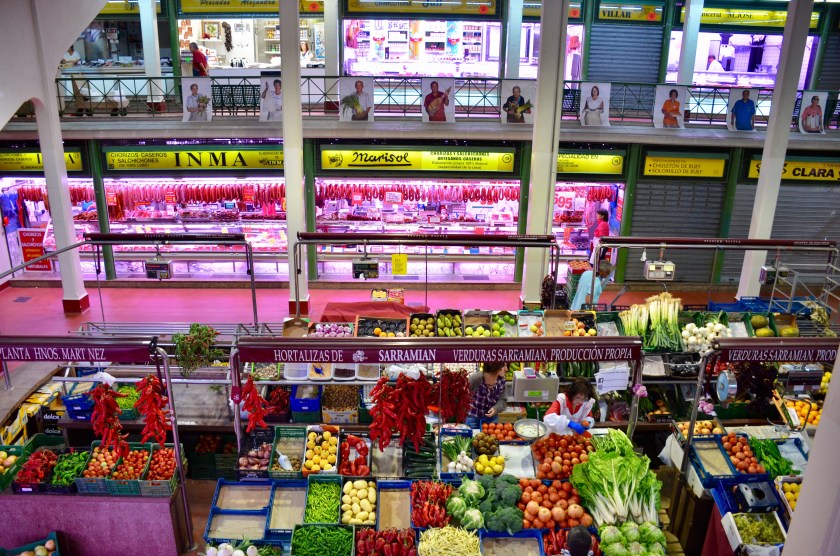
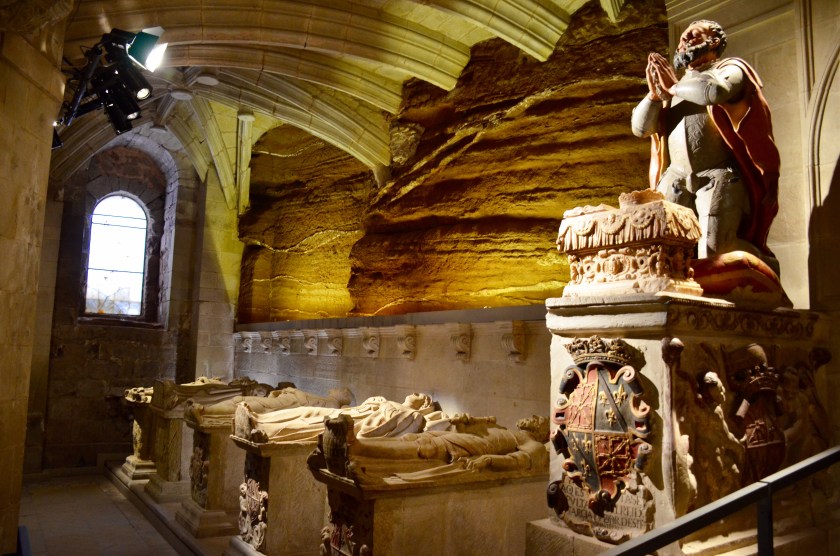
The 800 year old rooster at the cathedralThe fresh food marketEnormous onionsThe Tombs of the Navarran kings
Day 3 – Estella to Logrono
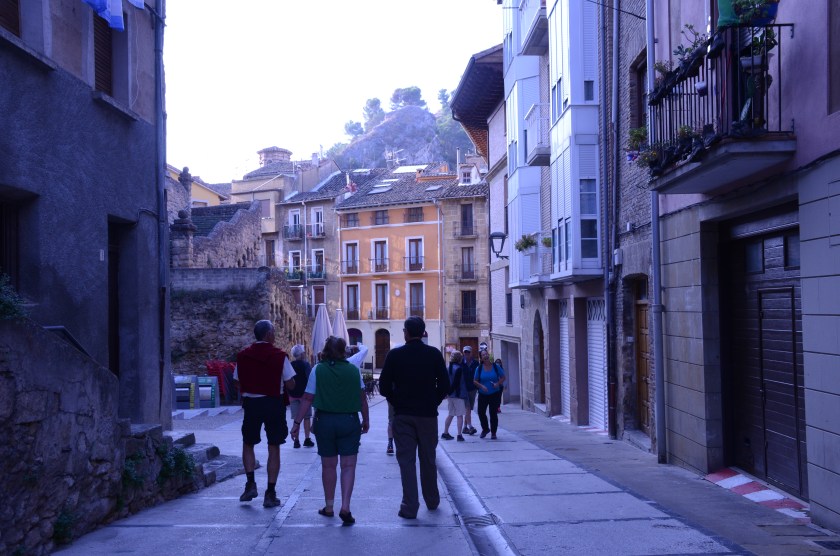
After a buffet breakfast, where we ate far too much of course, we set out on a tour of the pretty town of Estella, on the banks of the Ega River. Nancy told us more about Romanesque architecture and the history of the region, especially events and people of the 11th century. We visited the San Miguel Church (not to be confused with the San Miguel brewery, although we have been consuming plenty of that and other beverages) and learned more about Romanesque and Gothic architecture.
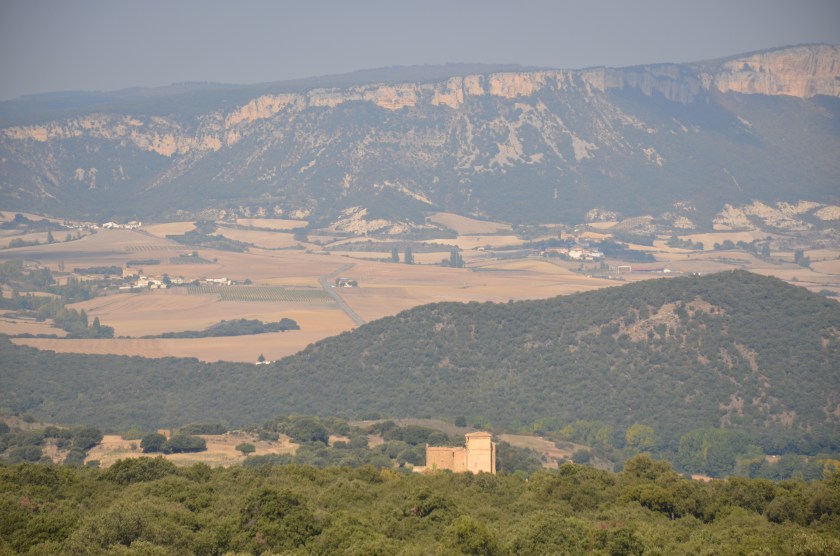
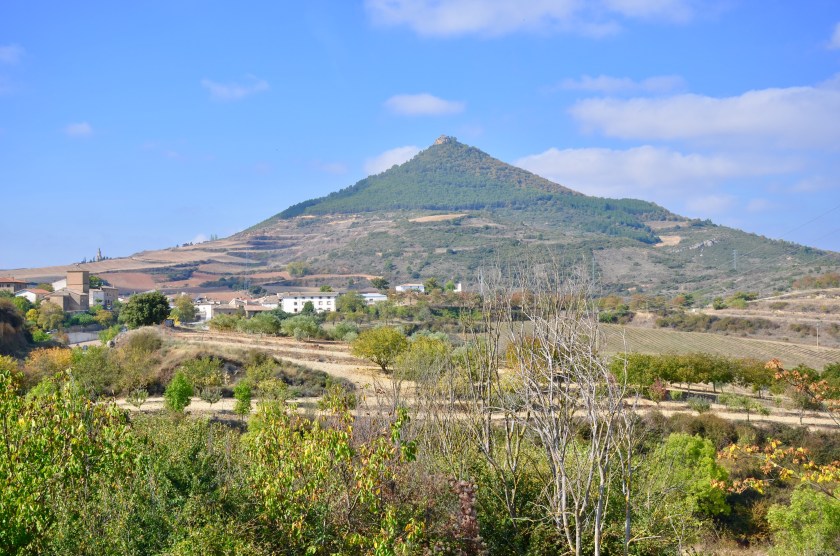
We then drove to our starting point for the day’s walk, which turned out to be a wine and water fountain to provide pilgrims with free wine (& water)at Irache Bodega! I was so overwhelmed, I forgot to take a photo! We then commenced our walk for the day. Once again it was much hotter than we anticipated and the walk was quite hilly, with little shade. We walked through farmland, seeing olive groves and grapevines. We arrived in Villamayor de Monjardin to another one of Jose’s amazing picnics, which we enjoyed overlooking the river and village.
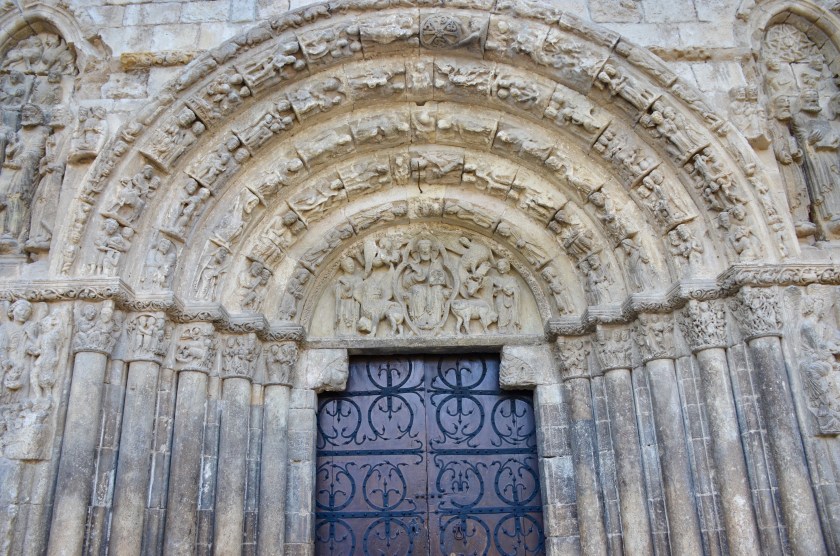
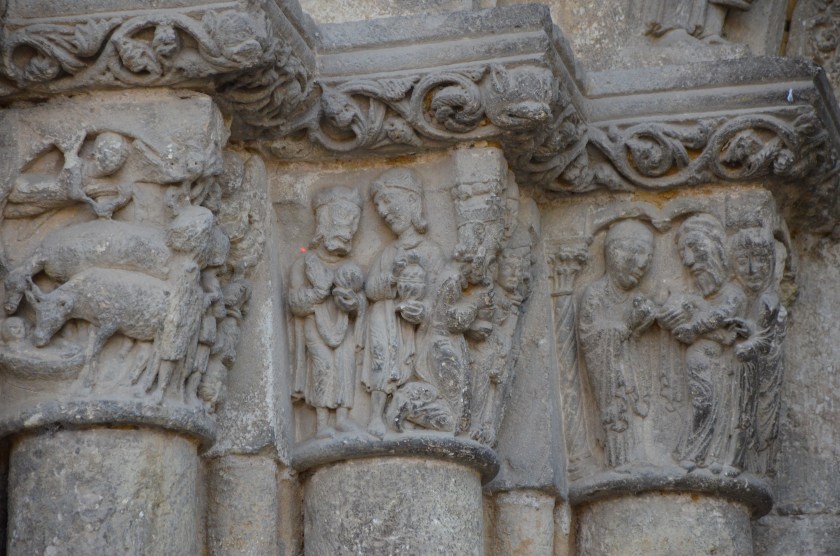
We then drove to Sansol for a short walk to the neighbouring village of Torres del Rio to look at another octagonal 12th century church. Nancy explained the carvings around the arched doorway and for the first time I noticed how gruesome some of the images used by the Catholic Church are. I can imagine how terrifying the results of sinning would have appeared to 12th century peasants and pilgrims. We then walked 3 kms to Nuestra Señora Chapel, looking out over the Basque mountains, before driving to our lodging for the night in a converted Monastery in Logrono.
After a quick shower and change of clothes, we drove to Rioja Winery for a tasting and tour of the winery. Expecting something similar to a wine tasting in the Hunter Valley, we were surprised to be met by an charming and entertaining guide, Jesus, who had all of us, especially the women, enthralled. We started with a tasting of a very nice white wine before following Jesus into the winery. As well as tanks and barrels of wine, there were some stunning stained glass windows and spectacular art and sculptures. We then returned to the tasting room to try three reds and an ice wine. John, the official tour geologist, was also asked to interpret the soil sample results recently conducted in some of the vineyards. Naturally, most of us bought at least one bottle.
We returned to our hotel and some of us walked down into the bar area to try pinxtos and local wines for dinner. We walked 15.3km for the day.
Day 4 – Logrono to Santo Domingo de la Calzado
John and I had a surprising start to day 4. We were first to breakfast and as we sat down another woman came in & I realised she was Australian by her accent and Kathmandu shirt. I asked her
“Where are you from?”
She replied “Queensland”.
I asked “Where?”
She answered “Mackay”
I said “We’re from Grasstree Beach”
She asked “Do you know Jo?”
“Yes, she’s my neighbour, we walk together every day & have drinks every Sunday afternoon!!”
Such a coincidence!
After breakfast, we visited the fresh food market – onions as big as John’s head – and the Logorno cathedral. The cathedral was very impressive, with a massive gold alter piece. It’s easy to imagine the awe that pilgrims felt when they entered cathedrals such as these. It’s also easy to understand why people became disenchanted with the immense wealth of the church and the reformation started.
After breakfast we drove to Najeera to visit the Sta Maria Real Monastery, built on the site of a miracle, said to have occurred when the son of the King of Navarra followed his hunting eagle and a dove, it’s intended prey, into a cave where he found the eagle, the unmolested dove and the Virgin Mary. Of course, this miracle was a sign that a monastery should be built on the site. The Monastery extends into the cave itself, and the tombs of the Navarran Kings were built as close to the spot the Virgin Mary appeared, to be as close to God as possible. John, now designated as authority on anything to do with rocks, examined the cliff face to identify bands of gypsum.
We then drove to Azofra to commence walking to Ciruena. We walked through rolling farmlands, with grapevines used for red wines like the ones we tasted the previous night. Although the weather was cooler, I felt like I struggled more with the walk and I was very happy to arrive at our picnic site. Jose had prepared a gorgeous salad, accompanied by local specialties and wonderful bread we could drizzle olive over. I hadn’t realised how much I like bread with olive oil before Jose’s picnics!
After lunch, we walked to Santo Domingo de la Calzado and our hotel. This walk was much easier. After checking in and changing, Nancy took us on a tour of the cathedral and told us the story of St Domingo, the saint for the unjustly accused. His most famous miracle occurred when the son of German pilgrims was hung after being framed for stealing the silver from the hostel the family stayed in. The distraught parents prayed for him all the way to Santiago. When they returned they expected to see his decaying body still hanging, but to their surprise they found he was still alive (don’t question how he survived without food and water while hanging by his neck). His overjoyed parents rushed to tell the judge who told them it could not be so and that if it was the roasted chickens he was eating would grow feathers and run away. This is precisely what they did! And in fact, those very chooks, still alive after 800 years, are on display in the cathedral!
We had dinner at our hotel, a converted Monastery that retained much of the original architecture. We walked 15.6km for the day.
Over the last two days I have settled into the swing of he Camino. I have had the chance to get to know the other members of our group as well as talk to other pilgrims about their journeys. While there is a part of me that would like to be walking like they are, I am enjoying learning about the historical and political context of the Camino. To be continued…..
Our Camino has started! After thinking about it and training (or not) for it, it was all go at last. We all met at our hotel, Palacio Guendulain where we introduced ourselves and Nancy and Jose, our guides, gave us an overview of our walk. There are seven Kiwis, three Aussies and three Americans. Six are doctors and one is a barrister, meaning we should be fine if we injure ourselves and we will drink lots of wine! No-one appears particularly devout and we are all curious and enthusiastic about our journey. Nancy and Jose are very knowledgable and we will all get on well.
Day 1
After the meeting, we boarded the bus to travel out to Roncesvalles, in the Pyrenees mountains, just on the Spanish side of the French border, to start our adventure. We stopped at the Ibaneta pass which is the supposed point where Roland was defeated by the Basques when Charlemagne failed to respond to his trumpet call and which is the main crossing point for pilgrims starting their journeys in the south of France. Here, Nancy explained the yellow arrows and blue signs with yellow scallop shells that mark the path of the Camino to Santiago de Compestella. From Ibaneta Pass we walked through beech forest, in beautiful dappled light to Roncesvalles Abbey. Since the the Camino began, the Abbey has provided pilgrim accommodation and is an important landmark in the early stages of the French Way. When we arrived, pilgrims who had arrived earlier in the day were sitting around talking and looking around the 14th century buildings. We then continued walking through forest and farmland to Espinal, and then returned to Pamplona by bus. In total, we walked just over 8km, only a small proportion of that walked by pilgrims without bus backup. After seeing the steep slopes of the Pyrenees, I am in awe of them. Day 1 ended with a great local meal, accompanied by some very nice local wines.
Day 2
Our second day started with a walk through the old town of Pamplona. Nancy showed us the route that the bulls fun during the San Fermin festival & told is about the medieval history of the town, giving us context to what we had seen on our earlier walks. Then it was onto the bus to Zariquiegul to start our walking for the day. The walk consisted of a long upward stretch, through farmland before a steep descent to the village of Uterga where there was a bar with toilets and where Jose would have a picnic lunch prepared – powerful incentives! The walk was more challenging than the previous day’s walk, with the uphill section certainly getting the cardio working. It was also much hotter than we had expected – somewhere in the low 20s. We estimated it reached the high 20s, or even the low 30s, leaving several of us wondering whether we would have bags full of cold weather clothes we wouldn’t wear.
We passed and were passed by other pilgrims and started to get used the the Camino greeting “Bueno Camino”. There was a large sculpture where the trail reached the ridgeline depicting pilgrims traveling on foot, on donkeys and horses. There was also a van selling refreshments and another, owned by one of the hostels further on, offering free transport of backpacks for pilgrims who stayed at the hostel! Nancy warned us that the next downhill section was steep and uneven and to take care. However, it wasn’t as bad as some of the sections around the back of Grasstree Beach where we had been training and we all reached the flat section, and then the bar safely. Although one of our party, nameless at this stage since he is a barrister, managed to misplace himself somewhere on the 20m between the bar & our picnic…
After lunch we drove to Puente la Reina, stopping at an unusual octagonal shaped church that may have been connected to the Knights Templar, back in the 12th century. Here, Nancy started to teach us about the different styles of architecture we would see in the churches and cathedrals along the Camino – who would have thought I’d be able to distinguish Romanesque from Gothic, Renaissance and Baroque?? Puente la Reina is one of the little towns that were built in the 12th century specifically to cater to the pilgrims, providing food and lodgings and any other needs. It is a pretty little town with an 11th century arched bridge spanning the river. We then walked between two villages, Maneru and Cirauqui, finishing the section walking along a Roman road, still in remarkable condition in some sections. We walked 13.5km for the day.We then bussed to the town of Estella, staying at a restored flour mill. We finished the day with another excellent meal.
We have survived the first 2 days of Camino with no major catastrophes. We are all weary, but we have only walked a short distance compared to others walking the Camino, who also have the added disadvantage of carrying full back packs – some are very loaded down. The secret must be in carrying the bare minimum. Bring on day Three!
On our last night in Madrid we went on a tapas tour. Our host, Maria, was vibrant and passionate about her job, food, wine, her family, Spain and Galicia where her family lives. She took us to three bars to sample their tapas and wine specialities, all were delicious! The streets of Madrid were packed – happy people enjoying Saturday night out with friends and family. People have tapas by moving from one tapas bar to the next, so the streets are always busy. It is certainly a culture lacking in Australia. We liked Madrid and might go back after finishing the Camino. It seems a pity to miss the Prado Museum, Toledo and Sergovia.
We had an early start the next morning to catch the train to San Sebastián. Madrid’s streets were still busy with the night before’s revellers, with long queues for pizza, even at 6am. Our train left from Puerto de Atocha Station, the site of the Madrid train bombing several years ago. The machine guns at the entrance were a reminder of the constant threat of terrorist attacks in Europe today. It is particularly evil to target ordinary people just living their lives.
We had splurged and were traveling first class. The first train to Zaragoza which travelled at 300km/hr was very comfortable – definitely a great way to travel in Spain. The countryside was very dry. The grain crop had recently been harvested and olive trees were the only crop we saw except for a few fields of corn. We changed trains in Zaragoza and headed north to San Sebastián. There were more villages as we neared the coast and the land became much greener, with a greater variety of crops. There were also large bird nests, presumably storks, on power pylons and rooftops. The top of hills ridges were lined with wind farms, but on this particular day the turbines were mostly still, little electricity being produced.
San Sebastián is a charming seaside town. La Concha Beach is protected by headlands, Igeldo to the east and Urgull to the west, with Santa Clara Island in the middle of the bay. Stone forts to defend the city from attack between the 16th and 18th centuries sit on each headland.
We arrived on Sunday and the town was busy with holidaymakers and visitors to the International Film Festival – probably explaining the cost and lack of hotel rooms when we booked. The beach was crowded, though the water looked cold, at least to we North Queenslanders.
In the afternoon we walked to the foot of Igeldo & caught the funicular to the top, where we found a small, old but still operational theme park, dating from 1912. The views over the town and ocean were spectacular. After traveling back down on the funicular we walked around the base of the headland to the Construccion Vaccia sculptures by Jorge Orteiza. The headland was made up of tightly folded beds of rock, which, naturally, John was very interested in!
That night, we went on a pintxos and wine tour of the old town with Jane and Michael. Similar to having tapas in Madrid, we moved between the different bars to sample each bar’s specialities. They used local products and we the standout pinxtos were prawns, mussels, foie gras and cheesecake. The local cider and txakoli wine were very easy to drink. We had lots of fun, but we weren’t too keen on all the standing up – the best pintxos bars do not have chairs and tables so we were on our feet all night. Why is it that it is harder to stand still like that than walk around?
The next morning, we woke up to rain & decided to book an express Spanish lesson for the afternoon. In the meantime, as the showers cleared, we walked up to the fort on Urgull, involving lots of steps – hopefully good practice for Camino. The fort was occupied by Napoleon and then San Sebastián was besieged by the British. Once again, the views across the city were spectacular! After another visit to old town for lunch (delicious of course), we went to our Spanish lesson, hoping to learn a few useful words and phrases to use over the next couple of weeks,p. It was lots of fun and hopefully a few words will stick in our minds! Our teacher was very funny & we enjoyed the afternoon.
The next morning we met up with Jane and Michael to catch the train to Pamplona. We arrived to bright sunshine & a beautiful town. Pamplona is the largest town in Navarre and is just south of the French border. Over the centuries, it has been a strategic stronghold for the Romans, Charlemagne, the Moore’s and Napoleon. These days it is most famous for the running of the bulls in July.
The old town was bustling. Pamplona is the first big town on the “French Way” and the pilgrims were easy to identify by their day packs adorned with scallop shells and a few even with wooden staffs. The scallop shells and staffs are traditional symbols of the Camino. We could not check into our hotel so we walked around the city walls, found the starting point for the running of the bulls and had a look through the museum, though it was hard to understand without English translations so we could put it into context.
We had lunch at the wonderful Cabello Blanco Spanish restaurant where we ate far too much and needed to wash it down with a few bottles of a very good local rose. We checked into the very luxurious Palacio Guendulainin the centre of the old town. The hotel was once a palace and there are old carriages and cars displayed near the foyer, large paintings on the walls and period furniture throughout the lobby and dining rooms. In the afternoon, John and I walked around the old town and to the bullring to see Hemmingway’s statue. We met a couple of Canadian women who were having a rest day in Pamplona. They laughed about sleeping in large dormitories with snoring pilgrims, sharing bathrooms & their excitement at arriving at a hostel where there were plastic covered mattresses and therefore, no bedbugs!
We have one more sleep now until our Camino starts. We have tomorrow morning (Wednesday) free and then we meet up with our guides and group at 2pm. Time to get ready!













 Day 3 – Estella to Logrono


 Talking the walk: A non-believer's journey along the Camino de Santiago