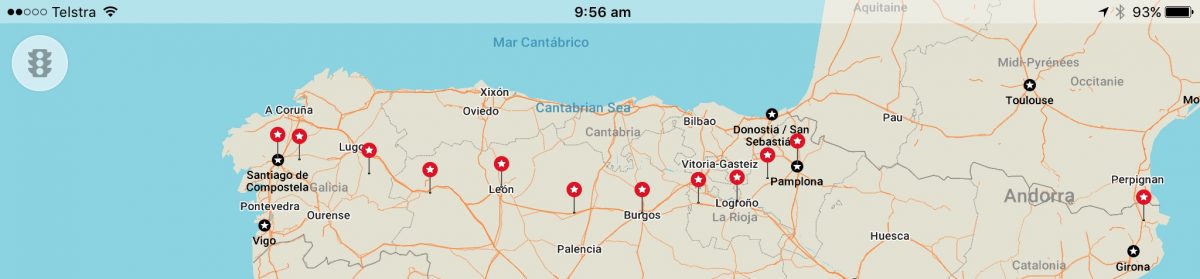


Our Camino has started! After thinking about it and training (or not) for it, it was all go at last. We all met at our hotel, Palacio Guendulain where we introduced ourselves and Nancy and Jose, our guides, gave us an overview of our walk. There are seven Kiwis, three Aussies and three Americans. Six are doctors and one is a barrister, meaning we should be fine if we injure ourselves and we will drink lots of wine! No-one appears particularly devout and we are all curious and enthusiastic about our journey. Nancy and Jose are very knowledgable and we will all get on well.
Day 1
After the meeting, we boarded the bus to travel out to Roncesvalles, in the Pyrenees mountains, just on the Spanish side of the French border, to start our adventure. We stopped at the Ibaneta pass which is the supposed point where Roland was defeated by the Basques when Charlemagne failed to respond to his trumpet call and which is the main crossing point for pilgrims starting their journeys in the south of France. Here, Nancy explained the yellow arrows and blue signs with yellow scallop shells that mark the path of the Camino to Santiago de Compestella. From Ibaneta Pass we walked through beech forest, in beautiful dappled light to Roncesvalles Abbey. Since the the Camino began, the Abbey has provided pilgrim accommodation and is an important landmark in the early stages of the French Way. When we arrived, pilgrims who had arrived earlier in the day were sitting around talking and looking around the 14th century buildings. We then continued walking through forest and farmland to Espinal, and then returned to Pamplona by bus. In total, we walked just over 8km, only a small proportion of that walked by pilgrims without bus backup. After seeing the steep slopes of the Pyrenees, I am in awe of them. Day 1 ended with a great local meal, accompanied by some very nice local wines.
Day 2
Our second day started with a walk through the old town of Pamplona. Nancy showed us the route that the bulls fun during the San Fermin festival & told is about the medieval history of the town, giving us context to what we had seen on our earlier walks. Then it was onto the bus to Zariquiegul to start our walking for the day. The walk consisted of a long upward stretch, through farmland before a steep descent to the village of Uterga where there was a bar with toilets and where Jose would have a picnic lunch prepared – powerful incentives! The walk was more challenging than the previous day’s walk, with the uphill section certainly getting the cardio working. It was also much hotter than we had expected – somewhere in the low 20s. We estimated it reached the high 20s, or even the low 30s, leaving several of us wondering whether we would have bags full of cold weather clothes we wouldn’t wear.
We passed and were passed by other pilgrims and started to get used the the Camino greeting “Bueno Camino”. There was a large sculpture where the trail reached the ridgeline depicting pilgrims traveling on foot, on donkeys and horses. There was also a van selling refreshments and another, owned by one of the hostels further on, offering free transport of backpacks for pilgrims who stayed at the hostel! Nancy warned us that the next downhill section was steep and uneven and to take care. However, it wasn’t as bad as some of the sections around the back of Grasstree Beach where we had been training and we all reached the flat section, and then the bar safely. Although one of our party, nameless at this stage since he is a barrister, managed to misplace himself somewhere on the 20m between the bar & our picnic…
After lunch we drove to Puente la Reina, stopping at an unusual octagonal shaped church that may have been connected to the Knights Templar, back in the 12th century. Here, Nancy started to teach us about the different styles of architecture we would see in the churches and cathedrals along the Camino – who would have thought I’d be able to distinguish Romanesque from Gothic, Renaissance and Baroque?? Puente la Reina is one of the little towns that were built in the 12th century specifically to cater to the pilgrims, providing food and lodgings and any other needs. It is a pretty little town with an 11th century arched bridge spanning the river. We then walked between two villages, Maneru and Cirauqui, finishing the section walking along a Roman road, still in remarkable condition in some sections. We walked 13.5km for the day.We then bussed to the town of Estella, staying at a restored flour mill. We finished the day with another excellent meal.
We have survived the first 2 days of Camino with no major catastrophes. We are all weary, but we have only walked a short distance compared to others walking the Camino, who also have the added disadvantage of carrying full back packs – some are very loaded down. The secret must be in carrying the bare minimum. Bring on day Three!
 Talking the walk: A non-believer's journey along the Camino de Santiago