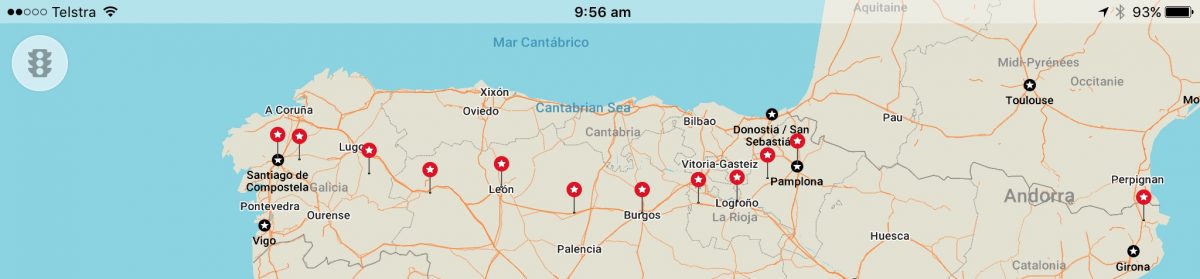
Day 10 – Arzua to Pazo de Andead.
The penultimate day of our Camino walk! It’s hard to believe that we are almost finished! And sad to think that it is almost over. After breakfast we drove to the town of Arzua. These days, you must walk a consecutive 100km to Santiago de Compostela to be granted your Compostela (meaning we will not be eligible), so Nancy warned us many walkers start their journey in Arzua. This was indeed the case, with coachloads of walkers, including school and university excursions and groups of elderly walkers, hitting the trail together, some struggling on the first few ascents. We had become accustomed to seeing only a few other pilgrims, but now we were surrounded by them! The cyclists were a particular hazard with packs of them zooming through the walkers without ringing their bells to warn of their approach. We also noticed the large numbers of walkers when we stopped for refreshments at bars along the way, particularly in the lack of tables and chairs and the queues for toilets. Most bars along the Camino only have one male and one female toilet and from the start, the women in our group had been using the men’s toilet as well, but on day 10 it became a little more difficult to slip into the mens’ so we had to wait longer.
Never-the-less, we had a pleasant walk, feeling that after conquering Day 9’s ascent, we had nothing left to prove. The shaded, tree-lined trail meandered through small villages of granite buildings, dairy farms, chickens and pigs and fields of corn and cabbages. Apple trees, laden with fruit, grew along the fence line. On the Camino, anything growing on the trail can be foraged, so the trees still had apples on the farm side of the fence but none on the branches overhanging the trail. John, being a natural hunter gatherer, managed to knock a few down from the high branches (on the Camino side) to sample. Much of the path was also shaded by giant oak and chestnut trees, which Nancy explained could be a couple of centuries old. The farmers train the branches to grow straight so they could be harvested for timber without killing the tree – very sustainable, at least for small-scale harvesting.
We convened for Jose’s second last picnic, which was superb as usual.. we are going to miss his picnics! We then drove to Santa Maria de Melide, in Coruna Province, to start the afternoon’s walk. Here, the oaks and chestnuts were replaced by pines and huge plantations of Tasmanian Blue Gums which are favoured to timber because they are quick growing. At times, we felt like we were walking in Australia with the whiff of eucalyptus in the air. However, as monocultures, the plantations are probably having a devastating effect on the local fauna and flora.
At the end of the walk we drove to the wonderful Pazo de Andeade, a rural manor, set in beautiful gardens, that has been converted to a hotel by the owners. After settling in, wandering around the garden and having a few wines, we were invited into the kitchen for a cooking lesson – roast chicken and vegetables and vegetable soup. One of the most special things we have noticed are the special relationships Nancy and Jose have with the business owners, usually family owned businesses, they deal with during their tours. The owners of Pazo de Andeade greeted Nancy and Jose like old friends, which says so much about the Nancy and Jose and On Foot in Spain.
We all welcomed bed, one more day to go! We walked 19.3km for the day.


Day 11 – Paco de Andeade to Santiago de Compostela
Our last day! Some of us were a little reflective over a delicious country-style breakfast. We had just 8km left to walk. When we looked back at the first exhausting 8km walk at Roncesvalles on Day 1 and compared it to our nonchalant 20km on day 10, we could see how far we had come. It is conceivable that after another week we would be able to rock out 30km/day without raising a sweat!
We regretfully said goodbye to Pazo de Andeade, wishing we could come back to spend a few more nights in such a special place. We walked though some more farmland and eucalyptus forest, it was hard to believe we were only 15km from Santiago de Compestela! We rejoined the bus which drove us through the outskirts of Santiago to Rua San Pedro to walk to the Plaza de Obradoiro, the cathedral and our hotel – Hostal Reyes Catolicos, the converted Monastery and another one of the paradores – monasteries and other religious buildings converted into hotels and run by the Spanish government. The old town and the plaza were packed with a mixture of walkers, cyclists and tour coach passengers. As we walked in, we had to avoid 2 tourist “trains” – one bright red and the other white – that were dropping off and collecting passengers. It was immediately clear that the Camino and tourism in general is Santiago’s main industry.
Nancy briefed us on our options for the next couple of hours. One option was the Pilgrims’ mass which is celebrated every day at noon in the Cathedral. Otherwise we would have free time until the mass was finished. John and I tossed up what to do. We were not interested in the mass itself, but Nancy had to me out that the incense burner would be swung for this mass, which happens only on special occasions. In the end, we decided to sit through the mass to see the incense burner.
Suspended from ropes from the ceiling and using an ingenious pulley system, 4 men raise the the lit incense burner to start it swinging on a north to south axis, so high that it almost hits the roof. The burner has only come loose a couple of times through history. Once was when Catherine of Aragon, Arthur Tudor and Henry VII’s future bride, was in the cathedral. Luckily, when the rope broke the south door was open as the burner flew out the door. There is no record of whether anyone was killed or injured, but the accident was widely acknowledged as a portent of bad luck for the ill-fated princess.
We were lucky enough to find good seats, although we had a confessional box behind us with a steady stream of young women confessing their sins and leaving in tears while the mass was going. We didn’t really understand what was happening since the mass was in Spanish & we were not Catholic, but the nun had a beautiful singing voice and the devout around us were fully engaged. I loved watching their faces. Then it was time to light and swing the incense burner, and I have to admit I was impressed as it flew high above our heads. I can imagine the affect on illiterate peasants and pilgrims in the Middle Ages!
We reconvened after the mass and drove up to Monte Pedroso, overlooking Santiago for our picnic. We could clearly identify the limits of the old town and the cathedral still dominates the skyline. This was the last of Jose’s picnics and we sat on granite benches around a granite table, which was uneven so we had to be careful we didn’t spill our celebratory wine.
When we finished eating we walked down the hill and then returned to the hotel to meet our guide for our tour of the cathedral and our hotel, previously a Monastery and a pilgrims’ hospital. Our guide was very engaging, telling us anecdotes about her 96 year old mother, mixed in among snippets of history. In our hotel she pointed out some funny and irreverent grotesques that the builders had snuck in several hundred years ago, she showed us where we could hug the statue of St James in the cathedral and pointed out the convent which is still a closed community of Carmelite nuns. There are only 20 elderly nuns left now, reflecting the difficulty the Catholic Church is having in attracting young men and women to the ranks, as education levels rise.
After the tour we had some free time before our final dinner, or as someone dubbed it, our last supper, in the hotel restaurant. Over our (very delicious) meal we each reflected on our thoughts during and about our journey. When day 11’s 8km is added in, I had walked 161.1km, not too bad over 11 days. I also think my ideas about what the Camino is changed over that time and I will reflect further about the meaning of Camino over the next while. It was great to do a trip like this with our friends and it was great to make new friends. We had a lot of laughs over the journey and these stories will form the basis of our long-term memories of Camino.
It was sad to say goodbye to Nancy and Jose who were driving home after the dinner and a few of the group who were booked on early flights the next morning. Our conversations and thoughts turned from our daily experiences to our immediate plans – returning home, going back to work and for John an me, another 8 days of traveling around Spain.
 Talking the walk: A non-believer's journey along the Camino de Santiago