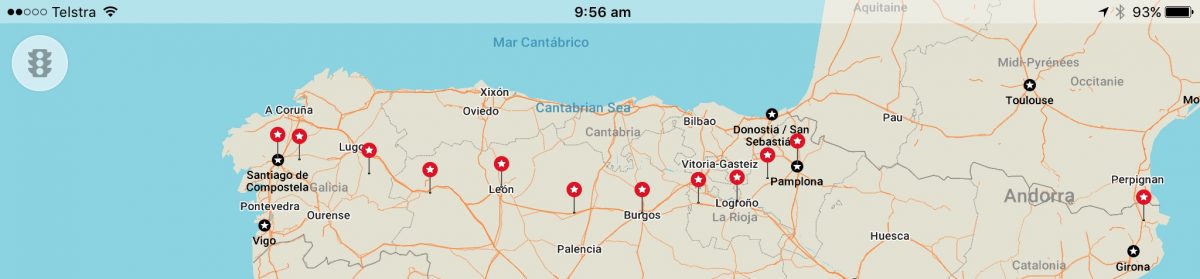
Now the Camino was over and we had visited Finisterre, we were starting the rest of our Spanish holiday. By the time we finished breakfast the morning after our trip to Finisterre, all our fellow Camino walkers, except for one couple, had left Santiago. A few days previously, John and I had booked air tickets to Madrid and then train tickets to Cordoba to see some of the places where the Muslims had ruled 1000 years ago. However, we weren’t due to fly out until 9.45pm, so we had the day to explore Santiago and do some shopping.
John and I had admired Nancy’s jet scallop shell pendant, symbolising the Camino. Jet is a form of coal with a high resin content which makes it harder and more solid and possible to carve without crumbling compared to coal. Sometimes it is referred to as black amber http://geology.com/gemstones/jet/. We had no trouble finding a pendant with matching earrings, but the geologist in John wanted one of the large uncut samples displayed with the jewellery. However, none were for sale and he had to be satisfied with a couple of small samples.
We bought some small gifts and then walked to Alameda Park where key attractions include four enormous Tasmanian Bluegums planted in 1848, the first outside Australia. Here we met our friends who were due to leave later in the afternoon. After paying homage to the trees, we returned to the old town and found a great café for lunch – more delicious Galician mussels and clams and beer of course! After they left we relaxed in the lounge of our hotel and wandered around some more until we felt we could almost eat dinner – lobster this time. Galician seafood was all I had expected and more. Super-fresh and simply cooked, it was equal or better to any seafood I have had anywhere. I need to learn how to cook it!
By the time Jose, our driver to Finisterre, arrived to take us to the airport we had seen plenty of Santiago. We were tired and struggled to stay awake on the short flight to Madrid. The hotel had upgraded us to an executive suite not much smaller than our house, but we were just grateful to fall into bed. We were meeting our guide at Toledo Station the next morning and needed to catch as much sleep as possible!
The next morning on the train to Toledo we noticed the huge difference in vegetation and landscape between this area and the verdant coastal regions we had walked through. People told us that large parts of Spain were in drought and the current run of hot weather was making conditions even dryer. Toledo, which dates to Roman times, is situated on a bend of the Tagus River and the steep cliffs provided formidable natural defences, augmented by ingeniously designed bridges and fortifications.
After the fall of the Roman Empire, Toledo became an important seat of royal and religious (Christian) power under the Visigoths. Following the Arab conquest in the 8th century, Toledo came under Muslim rule, and was the centre of numerous uprisings by rival Muslim groups and shifts in power over the next 300 years, although the Christian church and Jewish population coexisted throughout the Muslim era. In the 11th century, Alfonso VI of Castile took control of the city in the early stages of the Christian Reconquista. Initially, Christians, Muslims and Jews lived harmoniously, however, in the 15th and 16th centuries, persecution of the Jews resulted in their expulsion, forced conversion and murder (https://en.wikipedia.org/wiki/Toledo,_Spain).
Our guide was knowledgeable and refreshingly cynical about the Catholic church. While we knew that Australia is becoming increasingly secular and that the Catholic Church is struggling to attract priests and nuns, we didn’t realise it faced such problems in strong Catholic strongholds such as Spain. However, as our guide pointed out, a life of seclusion and celibacy is becoming less and less appealing to young, educated Spaniards. She also made interesting observations about the role of the confessional (a way of holding power over the confessor) and why the Catholic Church is so opposed to allowing priests and nuns to marry (not wanting to share the priest’s estate with recognised offspring).
We started the tour by driving to lookouts from where we could see the city and identify the old city walls. We then wandered around the historical and well restored Jewish quarter, visited the Mezquita-Iglesia de El Salvador, a 9th century mosque that had been converted into a Romanesque church, some Roman ruins discovered by a homeowner excavating to build a garage and the Roman Medieval Bridges. After the tour we had yet another delicious lunch (steak & partridge) and then went shopping. We bought some Damascus steel knives for which Toledo is famous and looked through a fascinating pottery shop that extended underground into the old passages that the Jews used to evade their persecutors. We would have bought some pottery if we had room to take it home. We accidentally arrived back at the station an hour before our train, so we had time to sit in the garden at the station bar and have a wine. Once back in Madrid, we went to a small restaurant across the road from the hotel for dinner. It seems excellent food is available everywhere in Spain!
We had planned to visit the Prado Museum the next morning before catching an afternoon train to Cordoba. However, the heightened threat of terrorism in Spain means that all bags are scanned for weapons before boarding trains. We were warned by the shop in Toledo where we had bought the knives that we would need to provide documentation for them every time we travelled by train. While we didn’t have trouble returning from Toledo where tourists who had purchased knives would be commonplace, we were concerned that we might have trouble on other routes – we still had 3 train trips booked. So we decided to post the knives home and by the time we had done that we had run out of time, so we didn’t make the Prado.. Maybe next time!
The train trip to Cordoba was very pleasant, we were even served a 3-course meal, complete with wine. We walked to our hotel and then took our first foray into the historic town of Cordoba… To be continued!


 Talking the walk: A non-believer's journey along the Camino de Santiago