Welcome to what I expect will be my final blog post. Since I started this blog I have been wondering about what I could and would write in this final section. There are really 2 sections: Spain in general and our Camino walk. Before we arrived, I expected the Camino to just be part of a larger adventure in Spain. But now it feels that not only were they separate events, but that the Camino was the headline event with the rest of our trip fitting around out Camino experience. I don’t know if that makes sense!
Spain – in general
We love Spain! I will always think of Spain as warm and sunny, even though some parts are supposed to receive many days of rain a year. Sadly, the wonderful weather we enjoyed means much of Spain is in drought. People were concerned about poor crops; large forest fires have ignited in Galicia and Portugal and there are reports that the grape harvest and wine production have been severely downgraded. We were lucky to travel through different regions and landscapes and through farmland, villages, towns and cities. We saw how people lived and made their living. We saw the verdant coastline and the drier interior and how the people, culture and architecture changed as we moved through these places.
We met wonderful, friendly people who were willing to help us and to engage in discussions about history, politics, religion and about all of Australia’s extremely dangerous animals. We had fantastic food – pintxos in San Sebastien, tapas in Madrid, amazing seafood, suckling pig and lamb, oxtail stew, bread and olive oil, pizza at La Fabbrica and of course, Jose’s salads! Then there was the wonderful wine everywhere! There was nothing I did not like. It’s sad to see the impact of international terrorism on a country that is increasingly dependent on tourism. The outcome of the Catalan independence movement could also have a detrimental effect, especially if it sparks similar movements in other parts of the country. We will just have to hope for the best and plan to return in the future.
The Camino
I thoroughly enjoyed our Camino experience. Nancy and Jose excelled in combining the physical challenge with the historical, cultural, social and economic contexts. I loved the sense of history and thinking that I was following the footsteps of people who lived hundreds and even thousands of years ago. Other walkers were unaware of many of the places, events and personalities we learned about and I am very happy we decided to do the Camino with Nancy and Jose from On Foot in Spain and I thoroughly recommend them https://www.onfootinspain.com/tours/.
In my first post I pondered two questions. 1) How I, as an atheist, came to be doing a walk on the Camino de Santiago, one of the world’s major pilgrimage trails? 2) What is an authentic Camino and would ours be authentic? Once we started, these questions changed in importance. I certainly didn’t find God or have a spiritual reawakening (we are still waiting for John to have his epiphany, messy or otherwise) and no-one in our group was overtly devout. In fact, most expressed scepticism about religion in general and the Catholic Church in particular. If anything, I became even more cynical. After seeing the enormous wealth and opulence on display in the cathedrals it’s easy to see why the Reformation started in the 16th century and why the Catholic Church is struggling to remain relevant in Europe and other traditionally Christian countries such as Australia.
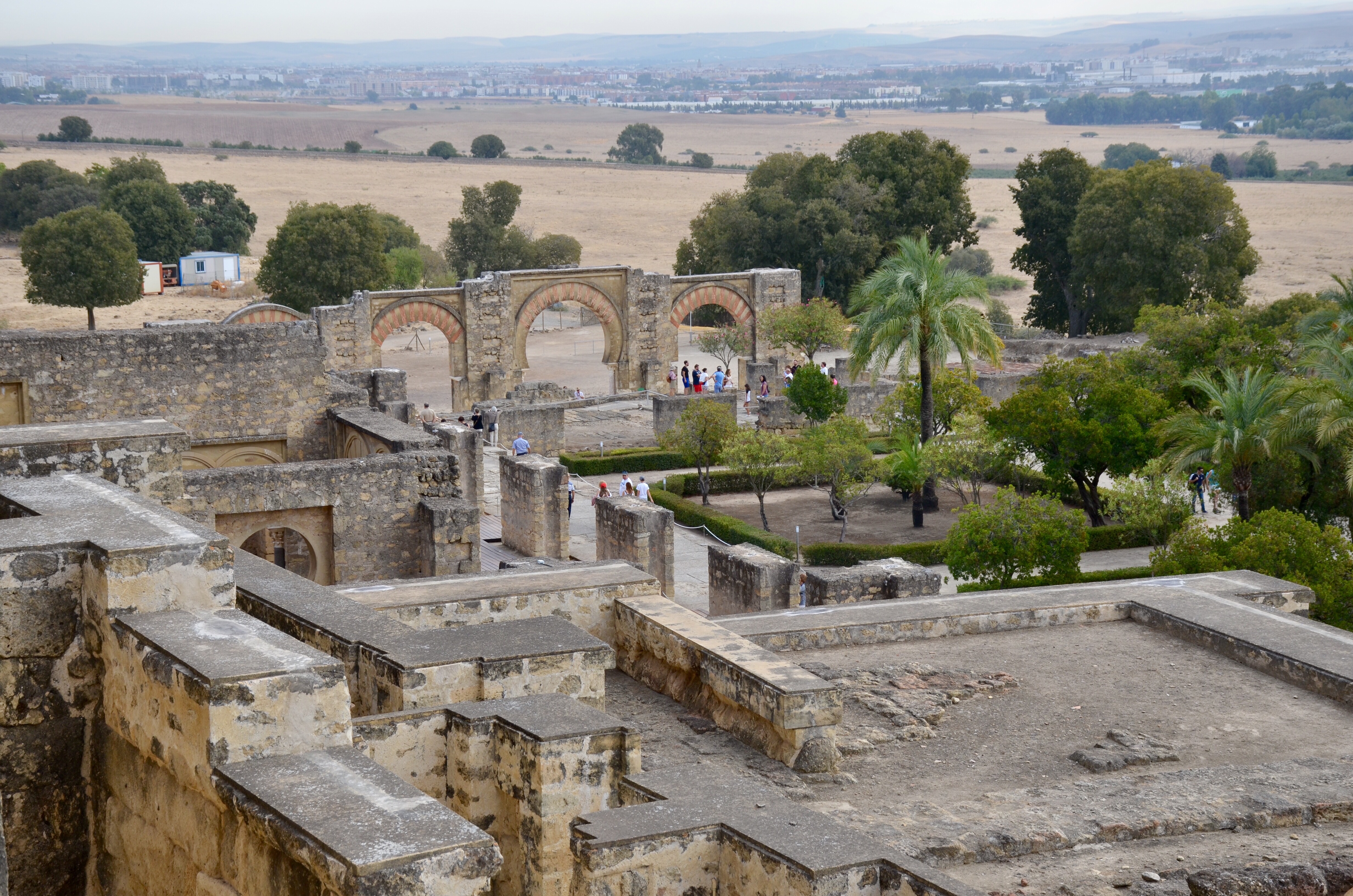
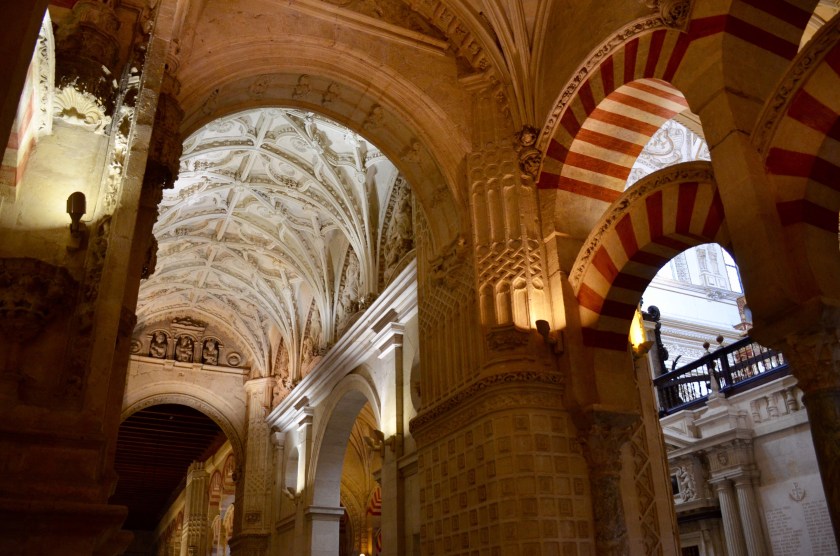
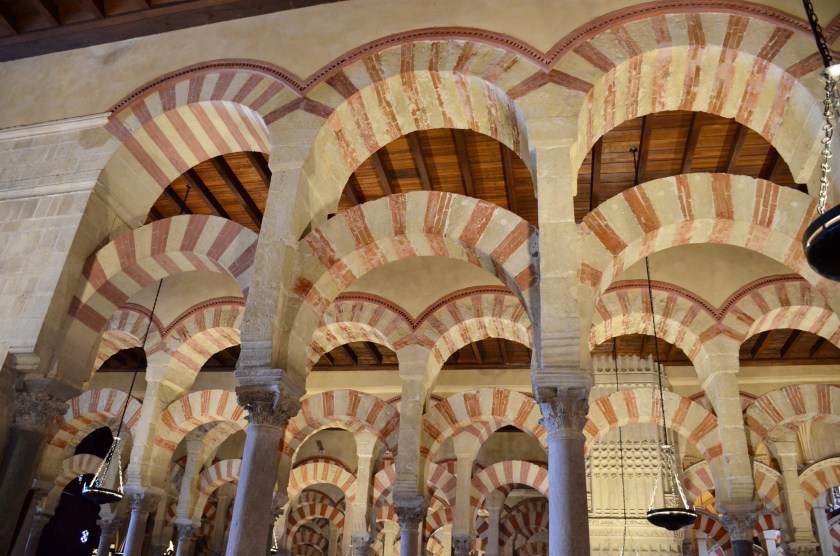
We discussed the relevance of religion with two of our post-Camino guides. While our extremely sceptical Toledo guide still believes there is a “higher power”, she thinks the Catholic church is only interested in perpetuating itself which it does by maintaining its power over people and increasing its wealth. Why, she asked, would anyone with an education enter the church for a life of celibacy and limited life experiences? Our guide in Cordoba, self-described as a non-practicing Catholic, agreed. The Church was losing relevance for young educated Spaniards who wanted to travel and build careers. Her mother attends church regularly to pray for her children. Our guide hadn’t realised the irony of her mother praying to the Christian God for her daughter to gain accreditation to take tourists through the Mesquite (Mosque) until I pointed it out!
On the other hand, there were many devout people attending the Pilgrims’ mass in the Cathedral in Santiago, with a confessional operating behind us throughout the proceedings, showing that the church retains significant power over people. It will be interesting to see how the Church deals with current scandals such a paedophilia by priests and child abuse in its orphanages and whether it will ever allow priests and nuns to marry to attract more people to religious roles. Or will it move its focus to developing countries in Asia, Africa and South America where it still has a stranglehold? The ascension this week of Chinese President Xi Jinping to a similar status as Mao Zedong must be sending shockwaves through the Chinese Christian community, predicted to have the largest number of Christians in the world by 2030 (http://www.telegraph.co.uk/news/worldnews/asia/china/10776023/China-on-course-to-become-worlds-most-Christian-nation-within-15-years.html) as his policies signal a return to those of the Mao era when Christians were persecuted.
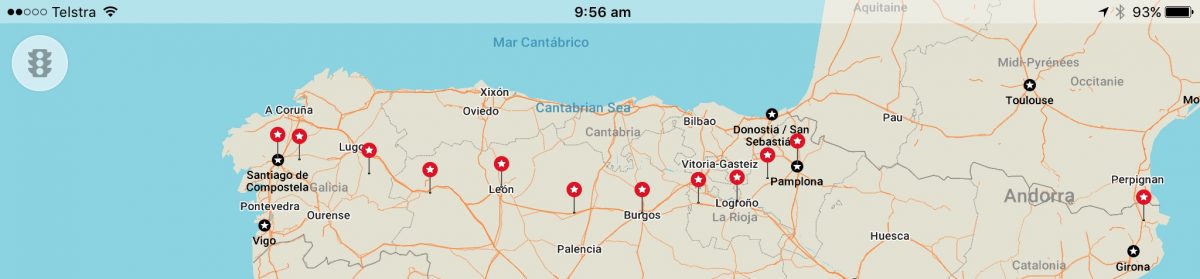
Secondly, I pondered whether our Camino, in which we walked selected sections and stayed in hotels rather than refuges, would be less authentic than that of someone who walked 799km. We unreservedly admired people laden with full backpacks for their stamina and motivation. We were very glad we were only carrying daypacks and were bussed through less attractive sections, the outer suburbs of towns and where the path was on the road. And that we had Jose’s lunch to look forward to every day. On the other hand, walkers who walk the final 100km to Santiago continuously are entitled to receive their compostella, meaning that even though we had walked 160km, 60km more than these walkers, we were not eligible for a compostella (something we knew before we started).
Nancy explained that until the recent incarnation of the Camino (the 1970s or so) the objective of the pilgrimage was to get to Santiago. It did not matter how you travelled, as long as you arrived and until the 20th century, the only ways of reaching Santiago were on foot or by pack animal. Nancy explained that everyone’s Camino is different and that no matter how much you do or how you do it, it is still your Camino. I am happy with this, I am proud of what I achieved and I congratulate those who walked 799kms. And, there is still a small me inside that thinks about walking that 799km!
Finally, how would I describe the Camino? Is it just another walk, like other famous long distance hikes and treks, or is there an additional, unique quality? While my experience of other treks is limited to only one other so I cannot answer this question authoritatively, one quality I observed was the sense of community, within our group, with other walkers and more widely, through space and time. We were lucky to be walking with a group that connected immediately. We spent a lot of time together in the bus, over meals and on the trail. The sense of community was also strong when we talked to others in bars, waiting for toilets or while walking. Questions about where we were from, where and when we started and how much time we had to do Camino were common. I remember being cheered on by a group of walkers sitting in a bar as we crossed a bridge into the town where we were staying for the night.
There was also a sense of community between the walkers and the people who lived and worked along the way, such as the bars, refuges and hotels. Walkers and business owners are interdependent – each relies on the other. Walkers need the businesses for consumables, food and refreshments, toilets, accommodation and to have their Camino passports stamped if they want their compostella. The businesses need the walkers to make a living. In the age of social media, with Facebook pages linking walkers at different stages of the Camino, it is critical for businesses to make a good impression on walkers who have the power to recommend some places over others to those following. Many businesses displayed the “Like us on Facebook” logo.
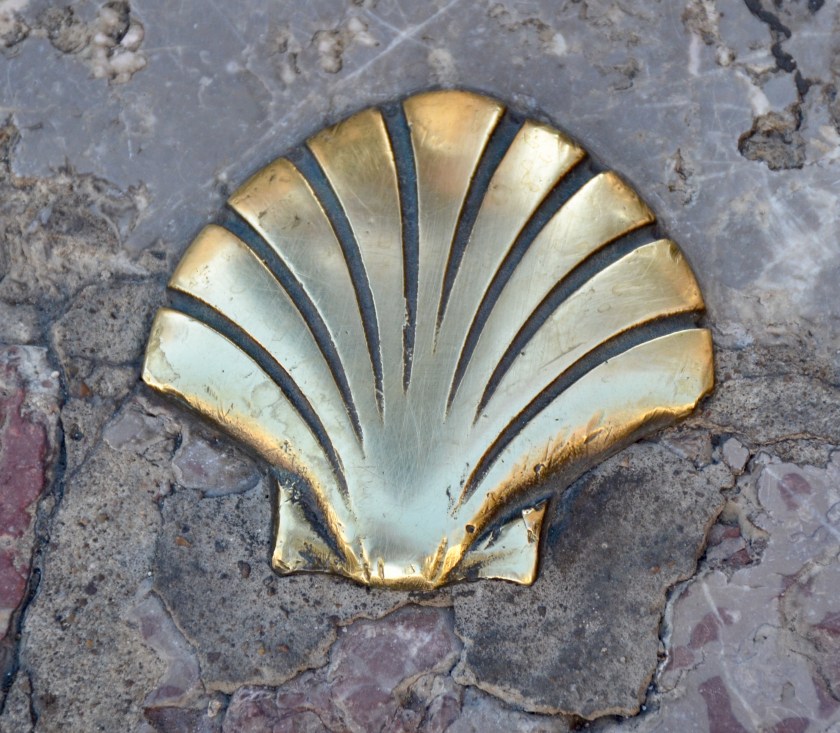
The concept of community across time is interesting. In the short-term, walkers transit along the Camino at different times and at different speeds, but almost always traveling from east to west (at least on the French Way). Fabia Tory, in “A book of not forgetting”, walked with some people for a while, then with others or by herself, later reconnecting with people with whom she had walked previously. She was joyous when she met up with old walking mates at the Pilgrims’ Mass in Santiago. Nancy Frey, in “Pilgrim Stories”, discussed the role of Camino groups in helping people readjust to post-Camino life. Since then numerous Facebook pages have been started to connect people, not only over space from different parts of the world, but also over time, connecting people who have finished with those at different stages of their journey and those yet to walk. They have shared interests and experiences that are unique to Camino walkers and by forming a community, can discuss their experiences, navigate difficulties settling back into their lives and potentially build long-term connections and friendships. The sense of community is also enabled by the symbolic cockle shell and yellow arrows, available along the way as keyrings, patches, fridge magnets and on items of clothing and as jewellery will serve to identify pilgrims when their paths cross at any time in the future.
I also a sensed a community extending over a longer timeframe. It was not difficult to imagine I was walking in the footsteps of pilgrims who preceded me by up to a thousand years, to imagine the way they travelled, the clothes they wore and the hardships they endured and to identify with them. This was especially the case when we visited 11th century towns like Puente la Reina that had been established specifically to cater to pilgrims. While backwards communication with the deceased, of course, is impossible, forward communication occurs in the form of: guidebooks such as “Codex Caliixtinus” dating as far back as the 12th century and numerous more recent guides; novels such as “Strong as death”, a murder mystery set in the 12th century, by Sharan Newman (1996, Forge) and “The Pilgrimage” by Paulo Coellho (1987, Thorsons); there are various histories of St James and the Camino available as well as autobiographies by famous and non-famous people about their Camino experiences. From such resources, potential walkers can learn something about the people who have walked before them, the historical background and what to expect as well as enabling them to identify with a community spanning a millennium. Is this different to other long distance treks and hikes? I guess there is only one way to find out!
I think this probably brings me to the end of my blog. The Camino, our time in Spain and writing this blog have all been great experiences. I would like to thank Nancy and Jose from On Foot in Spain https://www.onfootinspain.com/tours/ and all of our fellow travellers! We had a blast! And maybe I have inspired someone to do the same!!
Buen Camino!












 Day 3 – Estella to Logrono


 Talking the walk: A non-believer's journey along the Camino de Santiago